
.png)



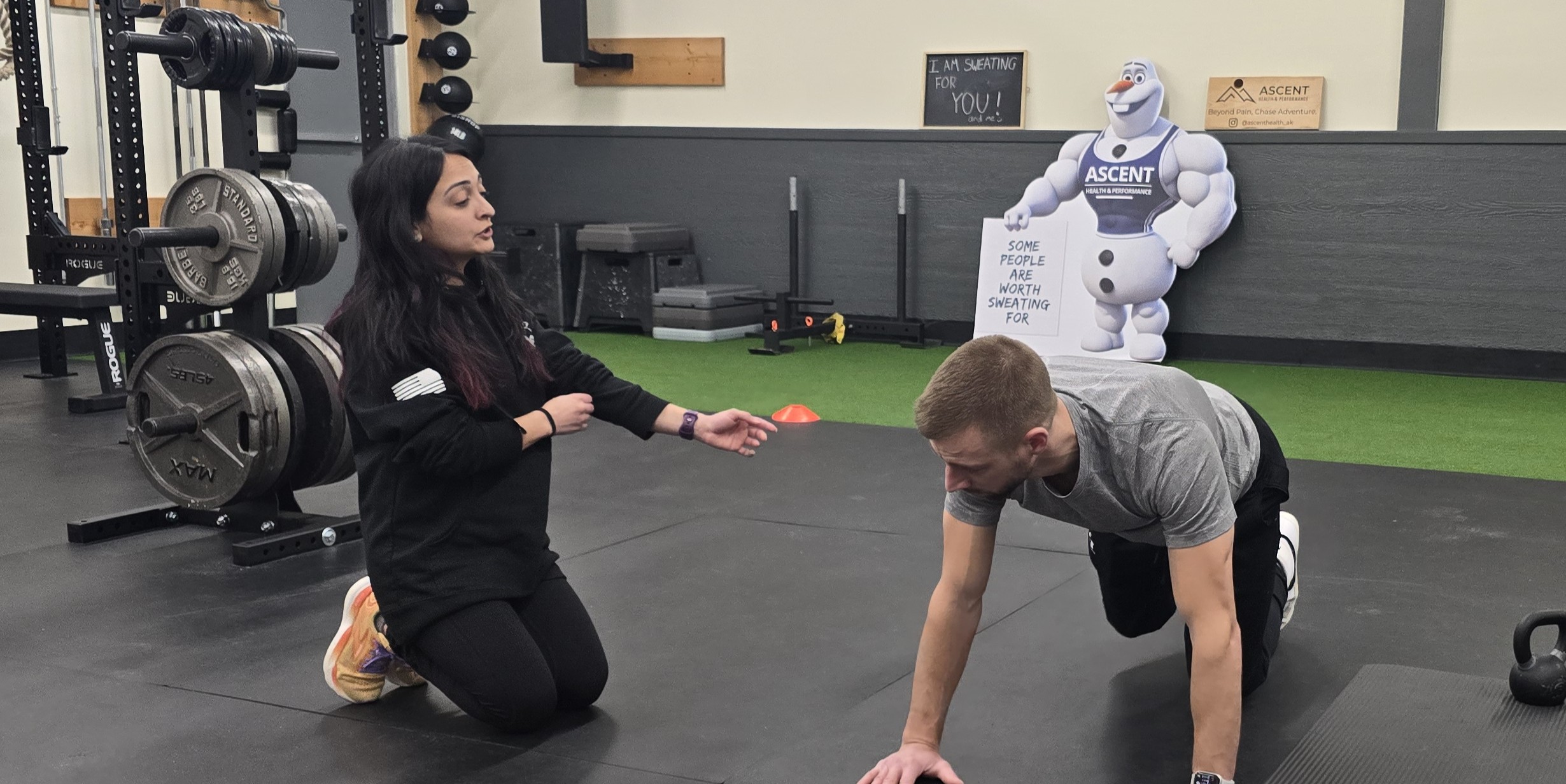

If you've ever been handed a list of rehabilitation exercises without a clear explanation of why you're doing them, when they should get harder, or what you're ultimately working toward, you've probably experienced one of the problems we try hard to avoid at Ascent.
Exercises aren't a rehab plan.
They're tools within a rehab plan.
You can accumulate a lot of good exercises without ever answering the bigger questions:
What are we trying to improve? How are we measuring it? And how do we know when you're ready for what's next?
One of the systems we use to answer those questions is something we call Rehab Buckets.
The framework gives us 11 broad movement capacities to evaluate. Each has a baseline and a standard, giving us measurable reference points rather than relying entirely on whether something "looks better."
It also helps bridge a gap that exists in a lot of rehabilitation:
How do we get from treating something that hurts to preparing someone for the things they actually want to do?
We Didn't Invent Rehab Buckets
It's worth giving credit where it's due.
We originally adopted the Rehab Buckets framework from Dr. Josh Satterlee and his Clinic-Gym Hybrid model, an approach built around helping clinicians bridge the gap between the treatment room and the gym.
Satterlee's system, in turn, incorporated elements of Certified Functional Strength Coach (CFSC) programming.
We've adapted the framework over time to fit the way we evaluate, rehabilitate, and train people at Ascent, but the underlying idea stuck with us for a very simple reason:
It gives rehabilitation somewhere to go.
Assess something.
Establish a baseline.
Train it.
Reassess it.
Progress it.
Instead of collecting exercises, we're building capacity.
What Are the 11 Rehab Buckets?
We organize the system into three broad areas: upper body, lower body, and core.
Upper Body: Vertical Press · Vertical Pull · Horizontal Press · Horizontal Pull
Lower Body: Bilateral Hip Dominant · Unilateral Hip Dominant · Bilateral Knee Dominant · Unilateral Knee Dominant
Core: Anti-Flexion/Extension · Anti-Rotation · Anti-Lateral Flexion
These aren't diagnoses.
They're broad categories of physical capacity.
Someone with knee pain doesn't automatically get a standard "knee rehab" program. Someone with low back pain doesn't simply get three exercises labeled as "low-back exercises."
The clinical examination helps us understand the condition we're dealing with.
The buckets help us answer another question:
What can this person currently do, and where are the meaningful gaps?
Baseline and Standard Give Us Something to Measure
Each bucket has a baseline and a standard.
The baseline gives us an entry-level measure of competency in that movement category.
The standard represents a higher level of usable capacity that we can work toward when it's relevant to that person's needs.
Depending on the bucket, we're looking at things like movement quality, control, repetitions, external load, time, or some combination of those variables.
We don't need patients memorizing a chart full of numbers.
What matters is that we're measuring something.
If you're currently below baseline, can we get you to baseline?
If you've reached baseline, can we progress toward the standard?
If you've reached the standard, does your job, sport, training, or lifestyle require more?
Now we're not simply saying:
"Your knee seems stronger."
We have a reference point we can revisit.
Standards Aren't Pass-or-Fail Tests for Being "Healthy"
This is an important distinction.
We don't use the buckets to divide people into "good movement" and "bad movement."
And falling below one of our standards doesn't mean something is wrong with you.
They're reference points—not diagnoses.
A 70-year-old who wants to comfortably hike, travel, and play with grandchildren may have very different requirements than a 25-year-old preparing for a competitive ski season.
Training history matters.
Injury history matters.
Age matters.
Your goals matter.
The real question isn't:
Did you pass every test?
It's:
Does the capacity we found match what you're asking your body to do?
That's where the framework becomes clinically useful instead of becoming a checklist.
Upper-Body Rehab Buckets
The upper body is divided into four broad patterns.
Vertical Press
Can you produce and control force in an overhead pressing pattern?
Vertical Pull
Can you produce and control force through an overhead pulling pattern?
Horizontal Press
Can you effectively produce force away from the body through a horizontal pressing pattern?
Horizontal Pull
Can you effectively pull toward the body while maintaining appropriate shoulder, scapular, and trunk control?
These patterns show up everywhere.
Putting something onto a high shelf. Pushing yourself off the ground. Pulling something toward you. Carrying and manipulating equipment. Strength training. Climbing. Skiing. Working overhead.
For someone recovering from a shoulder problem, simply achieving pain-free range of motion may be an important early milestone.
But eventually we need to ask:
What can that shoulder actually tolerate?
That's a much more useful question if the goal is getting back to real activity.
Lower-Body Rehab Buckets
For the lower body, we distinguish between hip-dominant and knee-dominant movement, and then look at each bilaterally and unilaterally.
Bilateral Hip Dominant
Can you effectively produce and control force through a hip-dominant pattern using both legs?
Think broadly about hinging, lifting, and using the posterior chain.
Unilateral Hip Dominant
Can you maintain that capacity when the demand shifts primarily toward one side?
This is where deficits that are easy to hide during two-legged movements can start becoming much more obvious.
Bilateral Knee Dominant
Can you produce and control force through a knee-dominant pattern using both legs?
Squatting is the easiest example.
Unilateral Knee Dominant
Can you produce and control force through a knee-dominant movement primarily using one leg?
Think stairs, split squats, lunging, running, hiking, stepping, skiing, landing, and countless athletic movements.
Separating bilateral and unilateral capacity is useful because being good at one doesn't guarantee you're good at the other.
And that's where this framework can start changing a rehab program.
Knee Pain Doesn't Necessarily Mean You Need More "Knee Exercises"
Imagine two people with anterior knee pain.
Both can perform a bilateral squat reasonably well.
One also demonstrates good unilateral knee-dominant capacity but has a meaningful limitation elsewhere.
The other struggles significantly when the task becomes single-leg.
Those two people have given us different information.
We can now investigate why that second bucket is limited and whether the deficit is relevant to the person's symptoms and goals.
Maybe we find a mobility restriction.
Maybe it's motor control.
Maybe the pattern is good but there's simply insufficient strength.
Maybe everything looks good until we add load.
The point isn't that a specific bucket explains every knee problem.
The point is that testing gives us a better question to ask next.
That's far more useful than automatically handing both people the same sheet of knee exercises.
The Three Core Buckets
Our core categories are a little different from the traditional idea of "ab exercises."
We're less interested in how many crunches someone can perform and more interested in whether the trunk can control forces while the rest of the body is doing something.
Anti-Flexion/Extension
Can you resist unwanted trunk movement forward or backward while maintaining position and transferring force?
Anti-Rotation
Can you resist rotational forces when something is trying to turn your trunk?
Anti-Lateral Flexion
Can you resist collapsing or bending sideways under load?
Think about carrying something heavy in one hand.
Picking something awkward up from the ground.
Running.
Skiing.
Pressing overhead.
Pulling.
Changing direction.
Your trunk is constantly managing forces created elsewhere in the body.
That's why our core rehabilitation often looks less like traditional abdominal exercise and more like learning to maintain position and transfer force under increasingly meaningful loads.
Finding a Gap Doesn't Automatically Mean We Train It
This is another important part of the system.
Let's say testing identifies one bucket that's noticeably behind the others.
That doesn't automatically mean we've discovered the cause of your pain.
And it doesn't automatically mean you need six weeks of exercises for that bucket.
First we ask:
Does this finding matter?
Does it reproduce or relate to the person's complaint?
Does it make sense given their activity?
Could it be limiting another movement?
Does their sport or job demand significantly more capacity there?
Or is it simply an interesting difference that has very little relevance?
Clinical reasoning still matters.
The buckets help organize information.
They don't replace the clinician interpreting it.
Don't Spend All Your Time Training What Someone Is Already Good At
On the other hand, when we identify a relevant gap, it gives rehabilitation focus.
If someone's bilateral squat capacity is already excellent, why spend most of the session doing increasingly creative versions of bilateral squats?
If their anti-rotation capacity is good, we don't need to keep adding core exercises simply because they came in with low back pain.
If they meet a standard, great.
That bucket may require maintenance, but it probably doesn't deserve the majority of our attention.
Find the relevant gap. Then put resources toward improving it.
This is one of the biggest advantages of having a system.
The Buckets Tell Us What. Our Progression Tells Us How.
This is where another part of Ascent's model fits into the picture.
You've probably heard us talk about:
Mobility → Stability → Strength → Power
Those aren't the Rehab Buckets.
They're a way we think about progressing capacity within a bucket.
Imagine someone is below where we'd like them to be in a unilateral knee-dominant movement.
Before simply strengthening it, we might ask:
Do they have the necessary mobility to access the position?
If the mobility is there, can they control the position?
If they can control it, can they progressively produce and tolerate more force?
And if their goals require it, can they eventually express that force quickly?
That's the relationship between the two systems:
The buckets tell us what we're working on. Mobility, stability, strength, and power help us decide how we're going to build it.
And importantly, we don't assume everyone has to start at mobility.
If you already have excellent mobility, you don't need six mobility drills.
If you're stable but weak, let's get stronger.
If you're already strong and your sport requires speed, impact, or rapid force production, we may need to spend more time developing power.
Start where the actual limitation exists.
Why Strength Matters So Much in This Model
At some point, rehabilitation needs load. Progressive strength training gives us a way to increase capacity beyond simply being able to perform a movement.
That's especially true when the life someone wants to return to is physically demanding.
Being able to perform an unloaded movement is different from being able to perform it with 50 pounds.
Doing something once is different from doing it repeatedly.
Moving slowly in a controlled environment is different from responding to unpredictable terrain while skiing.
This is why rehab and strength training eventually begin to overlap.
As symptoms improve and movement competency returns, we can gradually make exercises heavier, more complex, faster, or more similar to the person's actual activity.
That's not abandoning rehabilitation.
That's rehabilitation doing its job.
Where Hands-On Treatment Fits
None of this means we don't value hands-on care.
Quite the opposite.
Chiropractic adjustments, manual therapy, physical therapy interventions, and focused shockwave therapy can all have appropriate roles depending on the person and condition we're treating.
Sometimes pain is preventing someone from loading effectively.
Sometimes a joint restriction is limiting a movement.
Sometimes reducing irritability creates a much better opportunity to exercise.
The important part is what we do with that opportunity.
If treatment improves motion, use the motion.
If treatment improves tolerance to load, begin loading.
If a painful movement becomes comfortable enough to train, start rebuilding its capacity.
Whenever possible, we want what happens on the treatment table to connect to what happens on the gym floor.
Rehab Should Eventually Start Looking Like Training
For some people, that progression eventually leads out of formal rehabilitation and into coached group training or even personal training, where they can continue developing strength and capacity.
This is one of the things I like most about working in a clinic-gym environment.
The transition doesn't need to be abrupt.
Early on, someone may need more clinical care.
As things improve, the balance changes.
The exercises get heavier.
The movements become more demanding.
Treatment becomes less central.
Eventually, someone who initially came in because their back, shoulder, hip, or knee hurt may be deadlifting, squatting, pressing, pulling, carrying, jumping, or training alongside everyone else.
At some point it becomes difficult to tell exactly where "rehab" ended and "training" began.
That's a feature, not a problem.
Because the goal was never to become really good at rehabilitation exercises.
The goal was to get back to life.
What Are We Actually Preparing You For?
This is the final piece.
A standard gives us a useful target, but it doesn't necessarily give us the endpoint.
Your endpoint depends on you.
A recreational runner needs different capacity than a powerlifter.
A skier needs different capacity than someone primarily interested in comfortably working around the house.
A construction worker has different physical demands than someone working at a desk.
Here in Alaska, "normal life" can also be surprisingly physical.
We ski.
Hike.
Bike.
Hunt.
Fish.
Shovel snow.
Carry gear.
Pull sleds.
Pick our way across uneven ground.
And sometimes just try not to eat it on an icy parking lot.
Your rehabilitation should eventually prepare you for your version of normal.
That's why we use the Rehab Buckets.
Not because 11 tests can tell us everything about a person.
They can't.
We use them because they give us a repeatable way to identify meaningful gaps, establish measurable targets, and decide where rehabilitation should go next.
Assess. Establish a baseline. Train. Reassess. Progress.
That's a much better plan than collecting exercises.
Framework Acknowledgment
Ascent's Rehab Buckets framework was adopted from concepts taught by Dr. Josh Satterlee through his Clinic-Gym Hybrid model and adapted for use within our clinical and performance setting. Satterlee's approach incorporates elements of Certified Functional Strength Coach (CFSC) programming.
We've continued to adapt how we apply the framework based on our clinical workflow, patient population, and the demands of rehabilitation and performance at Ascent.