
.png)



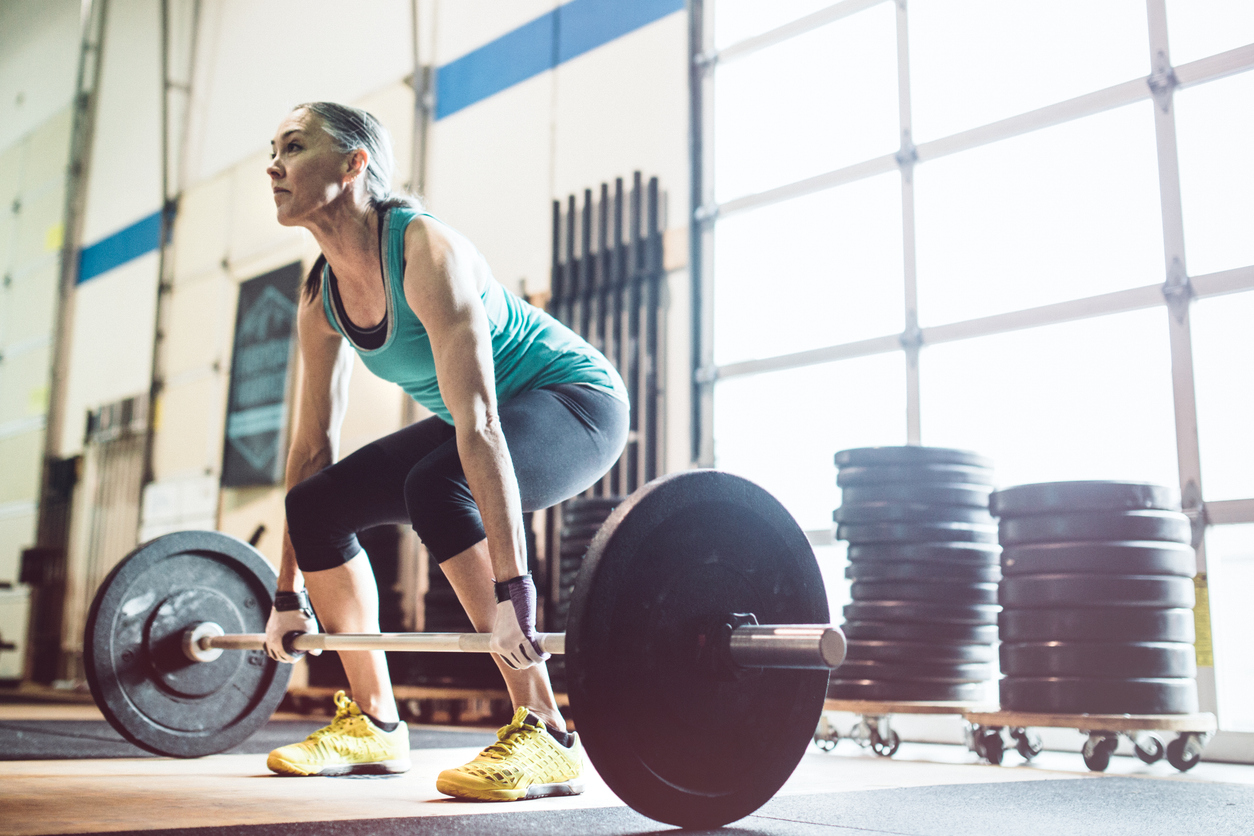

For a long time, strength training advice for women sounded very different from strength training advice for men.
Use lighter weights. Do more repetitions. Tone. Avoid getting too bulky. Stick with cardio. Maybe add some resistance training, but don't go too heavy.
Thankfully, that conversation is changing.
Women don't need a watered-down version of strength training. They need appropriately programmed strength training—and at some point, getting stronger requires progressively challenging the body with heavier loads.
That doesn't mean everyone needs to become a powerlifter. It doesn't mean maxing out a barbell every week. And it certainly doesn't mean loading exercises beyond what you can control.
It means learning how to lift well, gradually increasing what your body can handle, and becoming comfortable doing hard things.
The benefits can extend well beyond the weight room.
First: What Does "Lifting Heavy" Actually Mean?
Heavy is relative.
A 135-pound deadlift might be a warm-up for one woman and a major milestone for another. Neither tells us much without knowing the person lifting it.
When we talk about lifting heavy at Ascent, we're really talking about progressive resistance training: choosing enough resistance that your body has a reason to adapt and progressively increasing that challenge as you become stronger.
Sometimes that's a barbell.
Sometimes it's a kettlebell, dumbbells, cable machine, sled, or another form of resistance.
And if you're new to strength training, "heavy" may initially mean learning to squat, hinge, press and pull with a load that feels very manageable.
The important part is progression.
If you continue doing the same exercises with the same light resistance indefinitely, your body becomes very good at handling exactly that demand. To continue developing strength and capacity, the demand eventually has to change.
Women Are Very Capable of Getting Stronger
This isn't really up for debate anymore.
A 2026 systematic review and meta-analysis examined 126 studies involving 4,019 women and found that resistance training substantially improved muscular strength in both premenopausal and postmenopausal women. The researchers also found improvements in functional mass and reductions in fat mass.
Earlier research specifically examining resistance training in women has reached similar conclusions, finding substantial improvements in both upper- and lower-body strength along with increases in muscle size.
One particularly important takeaway is that women continue responding to strength training as they age.
In studies directly comparing older men and women completing the same resistance-training programs, women demonstrate robust relative strength adaptations. One meta-analysis actually found greater relative improvements in lower-body strength among women, although men tended to gain more absolute strength and muscle.
In other words:
There isn't an age where women suddenly stop being capable of becoming stronger.
And that matters because strength becomes increasingly valuable—not less valuable—as we get older.
Muscle Is Something Worth Keeping
We tend to think about muscle in terms of appearance.
I'd rather think about it in terms of capacity.
Muscle helps you carry groceries, pick up a child, move furniture, climb stairs, hike Alaska trails, ski, run, bike, travel, and get yourself off the floor.
Strength gives you options.
Maintaining muscle and strength also becomes increasingly important with age. Research in middle-aged and older women consistently shows that resistance training can improve muscular strength and functional capacity.
That's why I don't love framing strength training for women primarily around changing how their bodies look.
There are much bigger reasons to lift.
Heavy Strength Training and Bone Health
This is where the conversation becomes especially important for women.
Bone isn't an inert structure. It's living tissue that responds to mechanical loading.
To encourage adaptation, however, we need to give the skeletal system an adequate stimulus.
One of the best-known examples is the LIFTMOR trial, which studied supervised high-intensity resistance and impact training in postmenopausal women with low to very low bone mass.
The program included twice-weekly, 30-minute supervised sessions using high-intensity progressive resistance and impact loading. Early findings showed improvements in lumbar-spine and femoral-neck bone mineral density compared with a low-intensity home exercise group.
That's particularly interesting because these weren't young competitive athletes. They were postmenopausal women with already-low bone mass.
At the same time, we should be careful not to oversell the research.
Not every resistance-training study demonstrates meaningful improvements in bone mineral density, and systematic reviews describe the overall bone-density evidence as more mixed than the evidence for improvements in muscular strength and physical function.
So I wouldn't tell someone that lifting weights guarantees stronger bones.
I would say that appropriately prescribed resistance training provides a mechanical stimulus that matters to bone, while also improving the muscular strength and physical capacity surrounding it.
And simply moving very light weights forever may not provide the same stimulus as progressively loading the body.
You Probably Won't Accidentally Get "Too Bulky"
This concern still comes up, so it's worth addressing.
Resistance training can absolutely increase muscle mass in women. That's one of its benefits.
But substantial muscular development doesn't happen accidentally.
Building a large amount of muscle generally requires sustained training volume, adequate nutrition, progressive overload and a lot of time. Research in women shows that resistance training can produce muscle hypertrophy, but those adaptations develop gradually.
Getting stronger also isn't synonymous with getting dramatically larger.
Early strength improvements include neurological and technical adaptations: you become better at producing force, coordinating movement and performing the lift.
If your goal is to be stronger without specifically training for maximal muscle growth, your program can reflect that.
Then There's Confidence
This is harder to measure with a DEXA scan or a strength test, but it's one of my favorite things to watch happen in the gym.
There is something powerful about watching someone go from:
"I don't think I can lift that."
to:
"I've got it."
The first time you walk up to a loaded barbell, it can feel intimidating.
Then you learn how to brace.
You learn how to hinge.
You learn how to squat.
You add five pounds.
Then another five.
Eventually, something that once looked impossible becomes your warm-up.
That experience changes your perception of what your body is capable of doing.
And that confidence doesn't necessarily stay underneath the squat rack.
It can show up when you're carrying something heavy around the house. When you're hiking in the Chugach. When you're picking up your kid. When you're loading your own luggage into an overhead compartment.
You stop treating your body like something fragile that needs to be protected from challenge.
You start seeing it as something that can adapt to challenge.
Heavy Doesn't Mean Reckless
This distinction is important.
I want women lifting heavy.
I don't want anyone lifting heavier than they're prepared to control.
At Ascent, our approach to strength follows the same progression we use throughout rehabilitation and performance:
Mobility → Stability → Strength → Power
If you don't have the mobility to access a position, loading it aggressively isn't the first step.
If you can reach the position but can't control it, we need stability.
Once you can move through the pattern with good control, we can progressively strengthen it.
And once you've developed adequate strength, we can start expressing that strength more quickly and explosively when appropriate.
That's very different from simply throwing more plates on the bar.
Good Strength Training Should Be Progressive
You don't need to prove anything during one workout.
A good program gives your body enough challenge to create adaptation while still allowing you to recover and come back ready to train again.
That can mean gradually increasing:
- resistance
- repetitions
- sets
- range of motion
- movement complexity
- training frequency
- or the quality and control of the movement itself
Eventually, though, if the goal is becoming stronger, the resistance has to become meaningfully challenging.
Current U.S. physical-activity guidelines recommend muscle-strengthening activity on at least two days each week and specifically describe gradually increasing resistance-training intensity over time.
What If You've Never Lifted Before?
Perfect.
You don't need to get strong before you start strength training.
That's what strength training is for.
The starting point simply needs to match where you are today.
For one person, that may mean learning a bodyweight squat and hip hinge.
For another, it's learning how to deadlift a kettlebell.
Check out our Ladies Learn to Lift Program if you're seeking help getting started or just getting comfortable with the idea.
Someone else may already know the basic lifts and simply needs coaching, programming and an environment where she feels comfortable pushing herself.
That's exactly who we built Ladies Lift Heavy for.
The goal isn't to rush toward an arbitrary number.
The goal is to build a foundation that allows you to keep progressing for years.
What If You Have Pain or an Old Injury?
That doesn't automatically mean heavy strength training is off the table.
It may mean the path toward it needs to be more deliberate.
This is where Ascent's integrated model becomes particularly useful.
If pain, mobility restrictions or an old injury is limiting your training, our chiropractic and physical therapy team can evaluate what's actually preventing you from progressing. We can address the mobility and stability pieces when necessary, build strength through tolerable ranges, and gradually return you to more demanding training.
The objective isn't necessarily to keep you away from load.
Whenever appropriate, the objective is to prepare you for it.
Strength Training Should Prepare You for Your Life
You don't have to compete.
You don't have to chase a one-rep-max.
You don't have to make lifting your entire personality.
But being strong is incredibly useful.
Especially here in Alaska.
We carry skis. We move gear. We hike steep trails. We shovel snow. We lift bikes. We pick up kids. We drag coolers around. We do things that require our bodies to produce force.
Training should increase your ability to participate in those things—not simply burn calories for an hour.
For people who enjoy training alongside others, our group classes provide structured strength and performance training in a coached environment.
For women especially, strength training represents an opportunity to invest in something that can pay dividends for decades:
more strength, more physical capacity, a meaningful stimulus for muscle and bone, and greater confidence in what your body can do.
And yes—eventually that means putting some weight on the bar.
Sources
Isenmann E, et al. It's never too late: The impact of resistance training on strength and body composition in females across the lifespan – A systematic review and meta-analysis. Journal of Science and Medicine in Sport. 2026.
Hagstrom AD, et al. The Effect of Resistance Training in Women on Dynamic Strength and Muscular Hypertrophy: A Systematic Review with Meta-analysis. Sports Medicine. 2020.
González-Gálvez N, et al. Resistance training effects on healthy postmenopausal women: a systematic review with meta-analysis. Climacteric. 2024.
Watson SL, et al. Heavy resistance training is safe and improves bone, function, and stature in postmenopausal women with low to very low bone mass: novel early findings from the LIFTMOR trial. Osteoporosis International. 2015.