
.png)



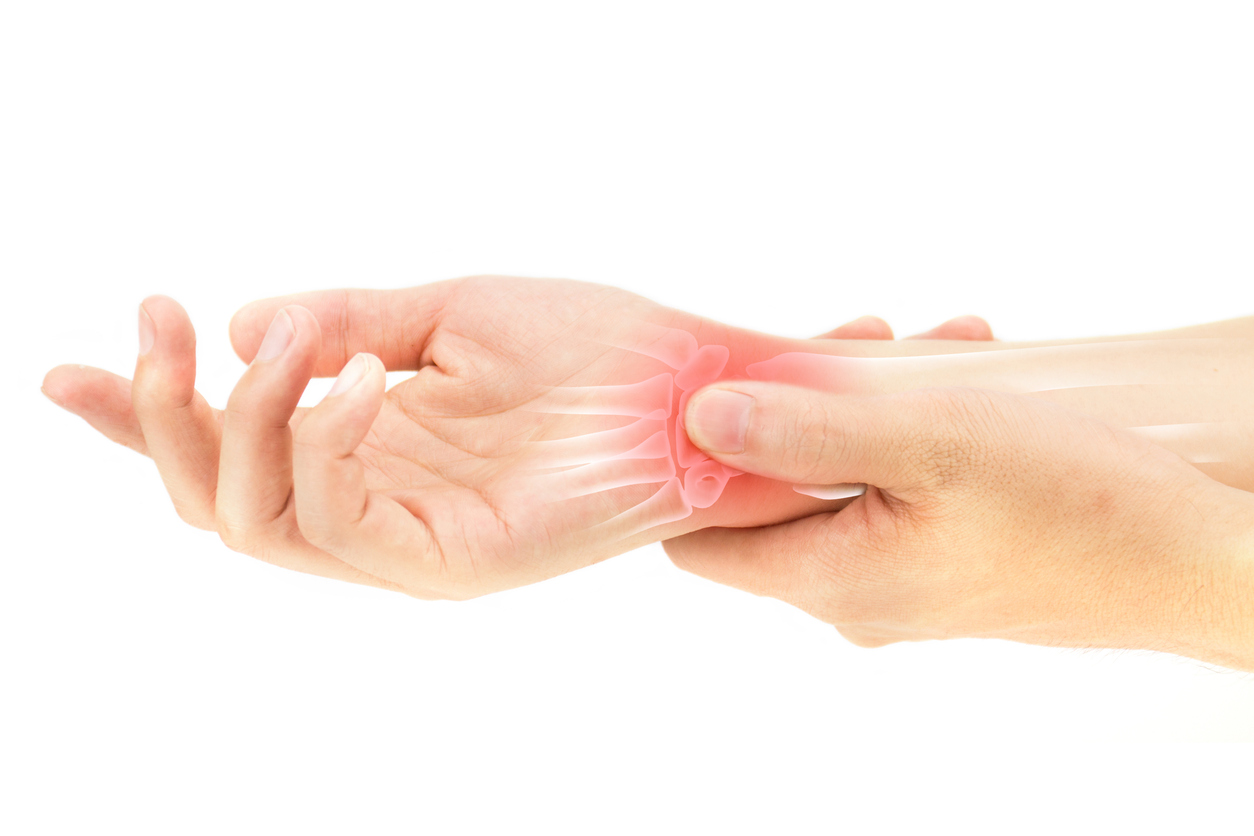

Wrist Pain Is More Than Carpal Tunnel
The wrist is a compact region containing eight small carpal bones, multiple joints, ligaments, tendons, nerves, and blood vessels. It must provide enough mobility for the hand to move freely while remaining stable enough to grip, lift, push, pull, and absorb force.
That combination makes the wrist remarkably capable—but also means several different problems can create pain in nearly the same area.
Wrist pain may develop gradually from repetitive gripping, computer work, lifting, climbing, or training. It can also begin suddenly after a fall, awkward catch, forceful twist, or other injury. Where the pain is located, how it started, and whether it is accompanied by swelling, weakness, clicking, or numbness helps us determine what may be involved.
Wrist Sprains and Strains
A wrist sprain occurs when a ligament is stretched or injured. A strain involves a muscle or tendon. Both may occur after a fall, sudden twist, hard impact, or unexpected force through the hand.
Symptoms can include:
- Localized pain and tenderness
- Swelling or bruising
- Pain with gripping or pushing
- Reduced wrist motion
- A sense of weakness or instability
- Discomfort when placing weight through the hand
Mild wrist sprains may improve with temporary protection and progressive movement. However, not every painful wrist after a fall is “just a sprain.” Fractures and more significant ligament injuries can initially look similar.
Persistent pain, substantial swelling, mechanical clicking, or difficulty bearing weight through the hand deserves a closer assessment.
Tendon Irritation and Overuse
Several tendons cross the wrist to control the hand and fingers. These tendons can become irritated when repetitive activity exceeds their current capacity.
Common contributors include:
- Repetitive gripping or pinching
- Sudden increases in lifting volume
- Climbing or racquet sports
- Frequent use of hand tools
- Cycling with prolonged pressure through the hands
- Push-ups, front-rack positions, and other loaded wrist-extension activities
- Repetitive computer or mouse use
Pain may occur on the palm side, back, thumb side, or little-finger side of the wrist depending on which tendon is involved. Symptoms often worsen when the irritated tendon is asked to work against resistance.
Rest may temporarily calm the area, but long-term improvement usually requires rebuilding the wrist and forearm’s ability to tolerate load.
De Quervain’s Tenosynovitis
De Quervain’s tenosynovitis affects two tendons on the thumb side of the wrist. It commonly causes pain near the base of the thumb that worsens with gripping, pinching, lifting, twisting, or moving the thumb.
People may notice symptoms while:
- Opening jars
- Picking up a child
- Carrying bags
- Using a phone
- Lifting a pan
- Gripping a barbell or dumbbell
- Performing repetitive work with the hand
There may also be swelling, tenderness, or a catching sensation along the thumb side of the wrist.
This condition is especially common during pregnancy and the postpartum period, when hormonal changes and the repeated demands of lifting and holding an infant can combine to irritate the tendon sheath.
Not all thumb-sided wrist pain is De Quervain’s. The nearby joints, scaphoid bone, sensory nerves, and other tendons can create similar symptoms, so the diagnosis should not rely on location alone.
Carpal Tunnel Syndrome
Carpal tunnel syndrome occurs when the median nerve becomes compressed as it travels through a narrow passage at the wrist.
Typical symptoms include:
- Numbness or tingling in the thumb, index, middle, and part of the ring finger
- Symptoms that are worse at night
- Hand numbness while driving, holding a phone, or gripping handlebars
- Reduced grip or pinch strength
- Frequently dropping objects
- Shaking the hand to relieve symptoms
The little finger is usually not involved because it is supplied by a different nerve.
Carpal tunnel syndrome is not simply wrist pain, and every numb hand does not have carpal tunnel syndrome. Nerve irritation can also occur at the elbow, shoulder region, or neck. Diabetes, thyroid disorders, pregnancy, inflammatory conditions, and previous wrist injuries may also influence nerve symptoms.
A complete evaluation should determine whether the median nerve is being irritated at the wrist, somewhere else along its path, or at more than one location.
Ulnar-Sided Wrist Pain and TFCC Injuries
Pain on the little-finger side of the wrist may involve the triangular fibrocartilage complex, commonly shortened to TFCC. This group of cartilage and ligaments helps stabilize the wrist where the radius and ulna meet.
A TFCC injury can occur after a fall, forceful twisting motion, or repetitive loading. It may also develop gradually through sports or work that repeatedly rotate or load the wrist.
Common symptoms include:
- Pain on the little-finger side of the wrist
- Clicking or catching
- Pain with turning a doorknob or using a screwdriver
- Discomfort during push-ups or when rising from a chair
- Reduced grip strength
- A feeling that the wrist is unstable
Not every case of ulnar-sided pain is a TFCC injury. Tendons, the distal radioulnar joint, ulnar nerve, and other local structures must also be considered.
Ganglion Cysts
A ganglion cyst is a fluid-filled lump that most commonly appears on the front or back of the wrist. Some are painless and mainly noticeable because of their appearance. Others can become uncomfortable when the wrist is loaded or moved through a particular range.
Ganglion cysts can change in size and may occasionally become difficult to see even though symptoms remain. Because other masses and joint problems can resemble a cyst, any new or changing lump should be properly evaluated.
Exercise and manual therapy may help with related stiffness or weakness, but they do not directly remove a ganglion cyst. A painful or persistent cyst may require medical imaging, aspiration, or consultation with a hand specialist.
Arthritis and Joint Stiffness
The wrist contains several joints, and arthritis can affect one or more of them. Osteoarthritis may develop after years of use, previous trauma, ligament injury, or fracture. Inflammatory conditions such as rheumatoid arthritis can also involve the wrist and hands.
Possible symptoms include:
- Aching or stiffness
- Reduced range of motion
- Swelling
- Pain with gripping or loading
- Symptoms that fluctuate with activity
- Progressive changes in hand or wrist function
Treatment depends on the type and severity of arthritis. Maintaining useful motion and strength is often important, but unexplained warmth, swelling, prolonged morning stiffness, or involvement of multiple joints may require medical assessment for an inflammatory condition.
When Wrist Pain Could Be a Fracture
A fall onto an outstretched hand can fracture the distal radius or one of the small carpal bones. The scaphoid, located near the base of the thumb, is particularly important because some fractures are subtle and may not appear clearly on the first X-ray.
Tenderness in the hollow at the base of the thumb—often called the anatomical snuffbox—after a fall should not be ignored.
Prompt evaluation is appropriate when wrist pain follows trauma and includes:
- Significant swelling or bruising
- Visible deformity
- Inability to grip or use the hand
- Sharp focal tenderness over a bone
- Pain near the base of the thumb after a fall
- Persistent pain despite an initially normal X-ray
Missing a fracture or significant ligament injury can lead to prolonged pain, loss of motion, instability, or arthritis. When the mechanism and examination suggest a structural injury, imaging and referral take priority over manual treatment or exercise.
Sometimes the Problem Extends Beyond the Wrist
The wrist is part of a larger system. The hand, elbow, shoulder, and neck all contribute to how the upper extremity manages force.
Restrictions at the elbow or shoulder may change how someone loads the wrist during lifting, work, or sport. Nerve symptoms in the hand may originate at the wrist, but they can also be influenced by irritation closer to the elbow, shoulder, or cervical spine.
Our related article on elbow pain explains how forearm muscles and nerves can produce symptoms that cross between these regions.
This does not mean every person with wrist pain needs treatment throughout the entire upper body. It means the examination should extend beyond the painful spot when the history and findings point toward a broader contributor.
How We Evaluate Wrist Pain
A useful wrist assessment begins by identifying how the problem started and which tasks have become difficult.
We may ask:
- Was there a fall, twist, or direct impact?
- Did symptoms begin after a change in work, training, or recreational activity?
- Is the pain on the thumb side, little-finger side, palm, or back of the wrist?
- Is there numbness or tingling?
- Does the wrist click, catch, or feel unstable?
- Are gripping, pushing, typing, or lifting painful?
The physical examination may include wrist and forearm range of motion, grip strength, resisted tendon testing, ligament assessment, neurological screening, and functional loading. The elbow, shoulder, or neck may also be examined when symptoms suggest nerve involvement or a regional movement problem.
Imaging is not required for every sore wrist. It becomes more important following meaningful trauma or when we suspect a fracture, major ligament injury, arthritis, cyst, or another structural condition that would change the treatment plan.
Treating Wrist Pain
Protect the wrist without abandoning movement
The first step may involve temporarily modifying the task that repeatedly aggravates the wrist. This could mean adjusting a lifting position, reducing gripping volume, changing hand placement, or using a brace for a specific period.
Bracing can be useful for certain conditions, including carpal tunnel syndrome, De Quervain’s tenosynovitis, and some sprains. However, a brace should have a purpose. Wearing one indefinitely without restoring motion and strength can leave the wrist less prepared to tolerate activity.
Restore motion and progressively reload the wrist
Rehabilitation may begin with comfortable range-of-motion exercises, isometric contractions, or controlled tendon and nerve movements. From there, exercise can progress to wrist flexion and extension, forearm rotation, grip training, carries, pushing, pulling, and task-specific loading.
The correct progression depends on what is involved. A healing sprain, irritated tendon, TFCC injury, and nerve entrapment should not receive identical programs.
Our physical therapy services connect symptom management with the strength and coordination required for work, lifting, sport, and everyday life. Exercises may also be reinforced through our rehabilitation video library so patients can review technique outside the clinic.
Manual therapy and chiropractic care
Manual therapy and joint treatment may help improve motion, reduce pain, and make exercise more comfortable when wrist or upper-extremity restrictions are contributing to the problem.
Our chiropractic care may include examination and treatment of the wrist, elbow, shoulder, upper back, and neck when clinically appropriate. Treatment may involve joint manipulation or mobilization, soft-tissue techniques, nerve-mobility work, and progressive rehabilitation.
Hands-on care can help create an opportunity for better movement, but lasting improvement usually requires the wrist to gradually regain strength and load tolerance.
Focused shockwave therapy
Focused shockwave therapy may be considered for select persistent tendon problems around the wrist, including some cases of De Quervain’s tenosynovitis or other chronic tendinopathies.
Shockwave is not an appropriate treatment for every wrist complaint. It would not be our answer for a suspected fracture, acute ligament injury, ganglion cyst, or unexplained neurological symptoms. The diagnosis and condition of the tissue should guide whether shockwave belongs in the plan.
When used, we pair it with activity modification and progressive loading rather than treating it as a substitute for rehabilitation.
When Should Wrist Pain Be Evaluated?
Consider scheduling an evaluation when:
- Pain persists despite modifying the aggravating activity
- Grip strength is declining
- Symptoms repeatedly return when activity resumes
- The wrist clicks, catches, or feels unstable
- Numbness or tingling affects the hand
- Wrist motion remains limited
- Pain interferes with work, sleep, training, or daily tasks
More urgent evaluation is appropriate after major trauma, with obvious deformity, rapidly increasing swelling, loss of sensation, significant weakness, changes in hand color or temperature, or focal bone tenderness after a fall.
Treat the Wrist You Have, Not Just the Diagnosis
Two people can both report wrist pain but need completely different plans. One may have an irritated tendon after a rapid increase in lifting. Another may have median nerve compression, a TFCC injury, or a fracture that initially looked like a sprain.
This is where a thorough clinical approach matters. We look at the painful tissue, the activity loading it, the function of the rest of the upper extremity, and what the person needs to return to doing.
The goal is not simply to make the wrist feel better for a few days. It is to identify the problem, restore useful motion and strength, and rebuild enough capacity for the wrist to handle real life again.