
.png)



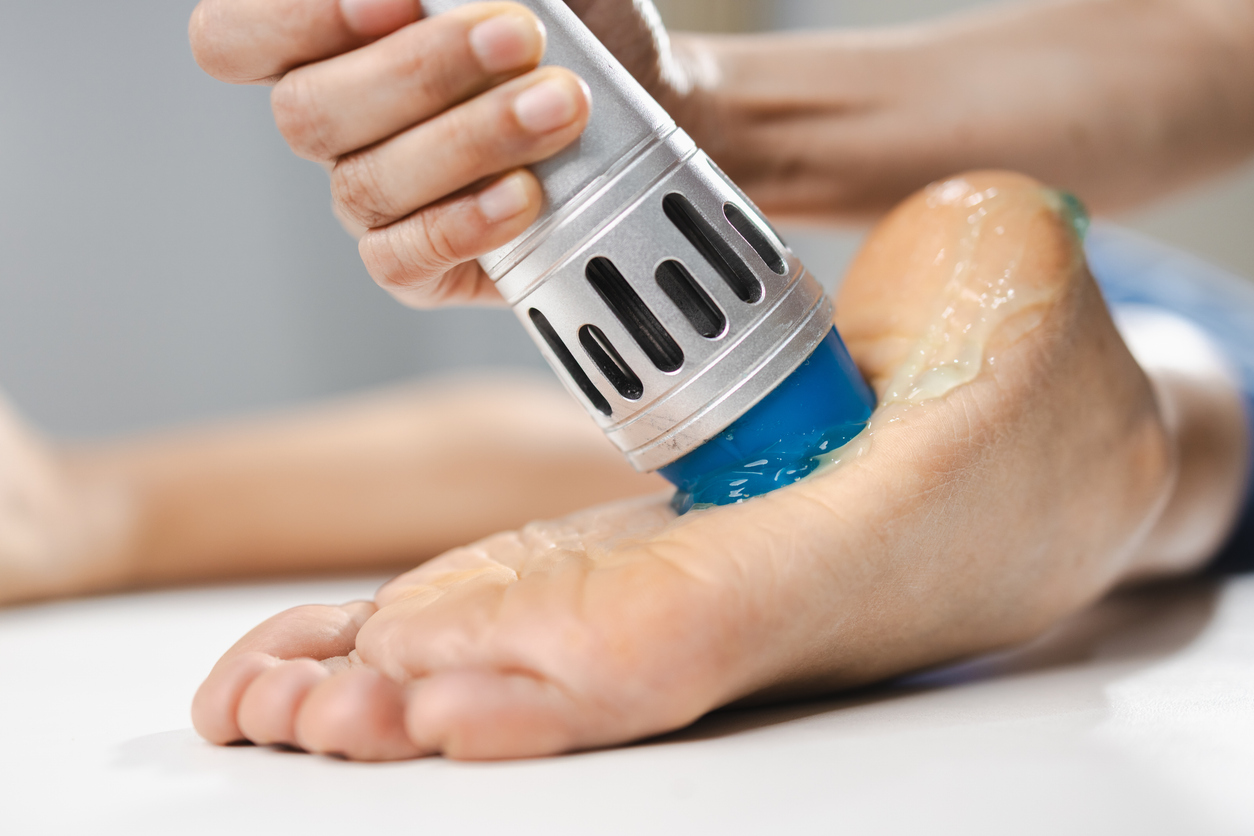

Plantar fasciitis has a frustratingly predictable pattern.
You step out of bed and feel a sharp, bruised or tearing sensation beneath the heel. It loosens after a few minutes of walking, but returns after sitting, driving or spending time off your feet. Longer periods of standing, running or hiking may make it increasingly difficult to ignore.
Many people spend months stretching, rolling the foot on a frozen water bottle, changing shoes or trying to rest it away. Those strategies may temporarily reduce irritation, but persistent plantar fasciitis often needs a stronger stimulus to change.
That is where focused shockwave therapy can be especially valuable.
Plantar fasciitis is one of the most researched and well-supported applications for shockwave therapy. When we combine that treatment with appropriate activity modification and progressive tissue loading, we are not simply trying to make the heel feel better—we are helping it become more tolerant of walking, standing, running and everyday life.
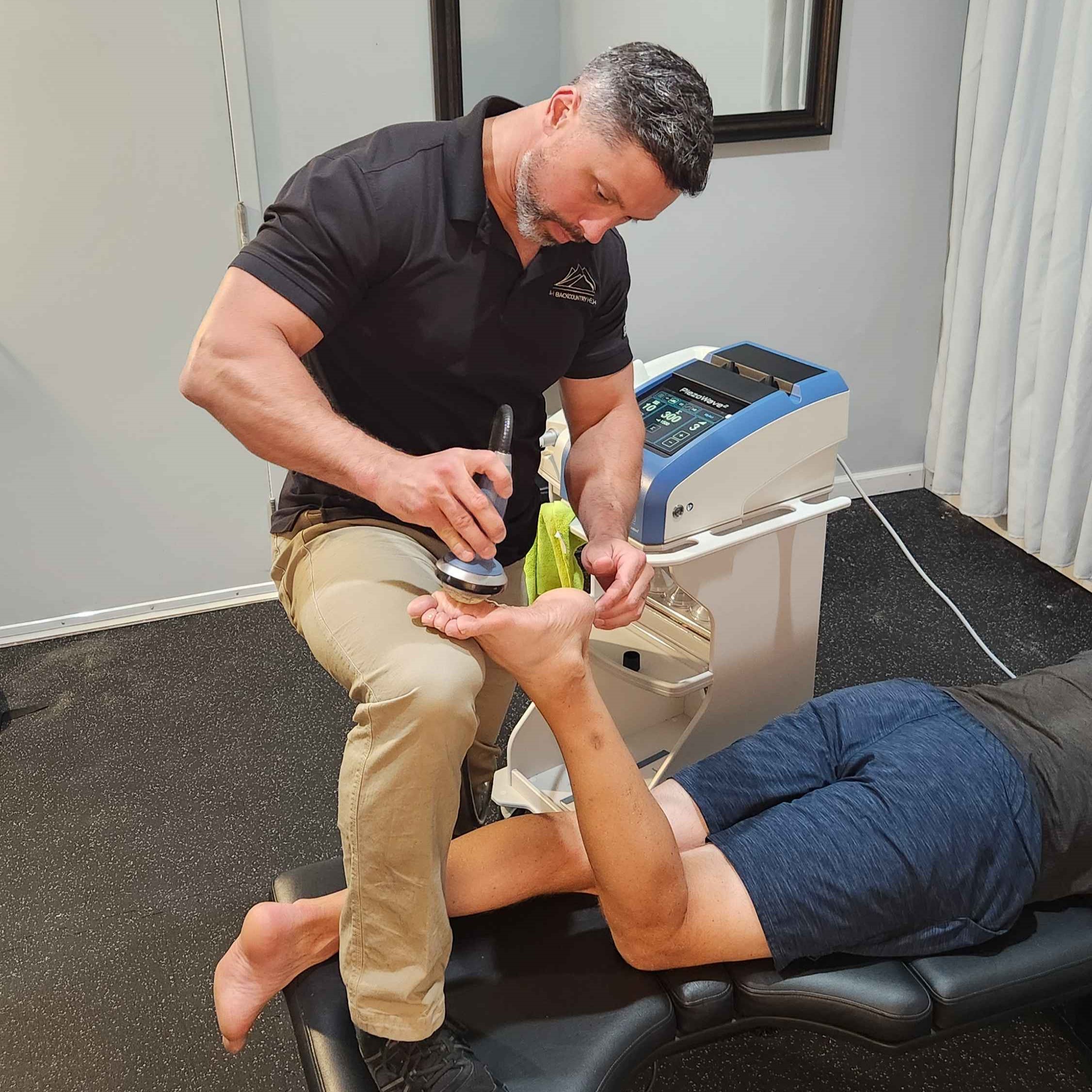
Dr. Tyler Wright uses focused shockwave therapy to target the plantar fascia and surrounding tissues at Ascent Health & Performance in Anchorage.
What Is Plantar Fasciitis?
The plantar fascia is a strong band of connective tissue running from the heel toward the toes. It helps support the arch and contributes to the transfer of force through the foot every time you stand, walk, run or push off the ground.
Plantar fasciitis typically produces pain near the inside-bottom portion of the heel, where the plantar fascia attaches to the calcaneus.
Common symptoms include:
- Pain during the first few steps in the morning
- Pain after sitting or resting
- Tenderness along the inside-bottom portion of the heel
- Pain after prolonged standing or walking
- Symptoms following an increase in running, hiking or other weight-bearing activity
- Heel pain that initially improves with movement but returns as activity continues
Despite the name, persistent plantar fasciitis is not necessarily an ongoing inflammatory problem. Chronic cases often involve a combination of tissue degeneration, increased pain sensitivity and a mismatch between the load placed on the plantar fascia and its current ability to tolerate that load.
In other words, the tissue is being asked to handle more than it is prepared to manage.
Why Plantar Fasciitis Can Become So Persistent
Your plantar fascia does not get many true breaks.
Even if you stop running or working out, you still have to stand, walk through the grocery store, move around at work and take the first few steps out of bed. That repeated exposure can make it difficult for an irritable plantar fascia to settle.
At the same time, completely unloading the foot comes with its own problem: tissue that is not being loaded does not automatically become stronger.
This creates a frustrating cycle:
- The heel becomes painful.
- Activity is reduced.
- Symptoms temporarily improve.
- Normal activity is resumed.
- The heel becomes painful again.
When this continues for weeks or months, another round of stretching or rest may not provide enough stimulus to meaningfully change the tissue.
Focused shockwave gives us a way to directly treat the persistently painful area without injections, incisions or extended downtime.
What Is Focused Shockwave Therapy?
Focused shockwave therapy uses high-energy acoustic pressure waves that converge at a defined depth within the body.
At Ascent Health & Performance, we use a PiezoWave2 focused shockwave system. This allows us to direct treatment toward a specific tissue target, such as the plantar fascia attachment along the inside of the heel.
That precision matters.
Plantar fasciitis is rarely painful across the entire bottom of the foot. Most people have a particularly sensitive region near the plantar fascia’s attachment to the heel, sometimes with additional tension or tenderness extending into the arch or surrounding muscles.
During treatment, we use the patient’s familiar pain pattern and our examination findings to locate the most clinically relevant tissue. The shockwave applicator can then be moved through that region while we adjust the treatment depth, intensity and number of pulses.
Focused Shockwave Is Not the Same as Every “Shockwave” Treatment
The term shockwave therapy is often used broadly, but there are important differences between focused and radial pressure-wave devices.
Radial pressure waves disperse outward from the surface. They can be useful for treating larger or more superficial regions.
Focused shockwaves converge at a selected depth, allowing energy to be concentrated more precisely within a defined tissue target. This is particularly useful when we want to treat the plantar fascia attachment at the heel rather than broadly applying pressure across the entire foot.
Both approaches have research supporting their use in plantar heel pain. However, focused shockwave is especially relevant when treatment requires a more specific target.
The equipment, treatment settings, tissue depth and clinical application all matter. Simply hearing that a clinic offers “shockwave” does not necessarily tell you what type of treatment is being provided.
What Does Focused Shockwave Do?
Shockwave therapy delivers a controlled mechanical stimulus to the involved tissue.
Cells can respond to mechanical input through a process called mechanotransduction. This is the same general principle that allows bone, muscle, tendons and connective tissue to adapt to appropriately dosed physical loading.
The full biological response to shockwave is still being studied. Current research suggests that shockwave may influence pain signaling, local circulation and cellular activity involved in tissue remodeling.
From a clinical perspective, focused shockwave may help:
- Reduce localized pain sensitivity
- Stimulate a new healing response in a persistently irritated area
- Improve tolerance to pressure and movement
- Support tissue remodeling
- Create a better opportunity to begin or progress rehabilitation
- Help patients return to walking and exercise more comfortably
We should be careful with claims that shockwave simply “breaks up scar tissue.” That explanation is catchy, but it does not accurately capture the more complex biological response we are trying to stimulate.
Shockwave is better understood as a controlled mechanical signal intended to change how the tissue responds—not a tool used to physically smash tissue apart.
What Does the Evidence Say?
Plantar fasciitis is one of the most extensively studied musculoskeletal conditions treated with shockwave.
A best-practice guide published in the British Journal of Sports Medicine combined systematic review findings with clinical expertise and patient experience. It concluded that shockwave had the strongest overall evidence among adjunctive treatments for plantar heel pain that was not improving with initial care.
The guide found support for focused shockwave in improving first-step pain across short-, medium- and long-term follow-up periods.
A large multicenter, randomized, placebo-controlled trial evaluated focused shockwave in 250 people with chronic plantar fasciitis. Participants received three treatments at weekly intervals. Twelve weeks after treatment, the focused shockwave group demonstrated significantly greater improvement in heel pain than the placebo group.
That study is particularly relevant because it evaluated the type of persistent plantar fasciitis we commonly consider appropriate for shockwave: symptoms that have continued despite previous conservative care.
Research is not perfectly uniform. Different studies have used different devices, energy settings, treatment intervals and inclusion criteria, and some earlier trials did not find a meaningful advantage over placebo.
That does not erase the positive evidence. It tells us that the type of shockwave, treatment protocol, diagnosis and patient selection matter.
Overall, shockwave remains one of the better-supported noninvasive options for persistent plantar fasciitis—especially when the initial approach of education, stretching, footwear changes and load management has not been enough.
What Does a Shockwave Session Feel Like?
Most people describe focused shockwave as rapid, concentrated tapping or pulsing against the heel.
We begin by identifying the area that reproduces the patient’s familiar pain. Treatment intensity is gradually increased according to tissue response and patient tolerance.
The most involved region may feel uncomfortable during treatment. That sensitivity can also help us confirm that we are treating the correct tissue. The goal is not to make the session unnecessarily painful, and the intensity can be adjusted throughout treatment.
A plantar fasciitis session may include treatment of:
- The plantar fascia attachment at the heel
- The medial or inside portion of the heel
- The plantar fascia through the arch
- The muscles along the bottom of the foot
- The calf and Achilles complex when clinically relevant
Temporary soreness, redness or mild swelling can occur afterward. Most people can walk out of the clinic and continue their normal day, although we may modify unusually strenuous activity depending on the irritability of the heel.
How Many Shockwave Sessions Are Needed?
There is no single protocol that fits every case.
Research trials have commonly used a short series of treatments separated by approximately one week. In practice, the recommended number of sessions depends on:
- How long the condition has been present
- The severity and irritability of the heel pain
- Previous treatment attempts
- The person’s daily activity demands
- Whether symptoms are improving between sessions
- The amount of tissue involved
- The patient’s rehabilitation and activity progression
Some people notice an early change in first-step pain or walking tolerance. Others improve more gradually over the weeks following treatment.
Shockwave is designed to stimulate a tissue response, so we do not judge its effectiveness solely by how the foot feels immediately after the applicator is removed. The response can continue developing between sessions and after the treatment series has ended.
Who Is a Good Candidate for Focused Shockwave?
Focused shockwave may be appropriate when:
- Plantar heel pain has persisted for several weeks or months
- Morning first-step pain remains significant
- Walking, standing or running tolerance is not improving
- The plantar fascia attachment remains distinctly tender
- Stretching, inserts, footwear changes or rest have provided incomplete relief
- Symptoms repeatedly improve and then return
- Heel pain is making it difficult to progress rehabilitation
- The patient wants a noninvasive option before considering injections or surgery
Shockwave does not have to be the first treatment attempted for every new case of heel pain. More recent or mild plantar fasciitis may respond well to education, footwear changes, taping, stretching and appropriate load management.
Its value becomes especially apparent when the condition has become persistent or when pain is preventing someone from rebuilding normal activity. If you need help deciding where to begin, start here.
Why We Still Support Shockwave With Tissue Loading
Focused shockwave is the centerpiece of this treatment approach, but the plantar fascia still needs to tolerate the demands placed on it after the treatment session.
We use rehabilitation to build upon the response shockwave creates.
That may include:
- Plantar fascia-specific stretching
- Calf and ankle mobility
- Foot-intrinsic strengthening
- Progressive calf raises
- Single-leg control
- Gradual return to walking, running or hiking
This does not mean every patient receives a long list of corrective exercises. The loading plan should be specific, manageable and matched to the person’s current capacity.
Shockwave addresses the painful and persistently irritated tissue. Progressive loading helps prepare that tissue for what it must do next.
The combination gives us a better path from pain relief to durable function.
Not Every Case of Heel Pain Is Plantar Fasciitis
Before treating the heel with shockwave, we need reasonable confidence that we are treating the correct condition.
Pain underneath or around the heel can also come from:
- Heel-fat-pad irritation or atrophy
- Calcaneal stress injury
- Nerve irritation or entrapment
- Referred pain from the lower back
- Inflammatory arthritis
- Plantar fibroma
- Achilles tendon disorders
Symptoms such as substantial swelling, night pain, numbness, progressive weakness, inability to bear weight or pain following a rapid increase in impact activity may require additional evaluation.
Shockwave is a powerful treatment tool, but it is not a substitute for an appropriate history and examination.
A Noninvasive Option for Persistent Heel Pain
Plantar fasciitis can linger for months when the tissue remains trapped between repeated irritation and inadequate loading.
Focused shockwave gives us a way to directly address that persistent tissue without injections, surgery or prolonged downtime. It has a meaningful body of research behind it, can be directed precisely toward the plantar fascia attachment and fits naturally into a plan that keeps people moving.
Rehabilitation still matters—but it supports the treatment rather than replacing it.
The goal is to use focused shockwave to reduce pain and stimulate a productive tissue response, then progressively prepare the foot for the demands of standing, walking, running, hiking and everything else waiting beyond the treatment room.
If persistent heel pain is limiting your walking, running, training, or time outdoors, learn more about our approach to plantar fasciitis treatment in Anchorage.
Sources
- Management of plantar heel pain: a best-practice guide
- Heel Pain—Plantar Fasciitis: Revision 2023 Clinical Practice Guideline
- Clinically relevant effectiveness of focused shockwave therapy in chronic plantar fasciitis
- Shockwave therapy for plantar fasciitis with ultrasonographic and patient-reported outcomes