
.png)



If you've ever opened your mouth and heard a click, pop, or snap right in front of your ear, you're definitely not alone.
Maybe it doesn't hurt at all.
Or maybe your jaw feels tight, chewing gets uncomfortable, you wake up clenching, opening your mouth feels uneven, or the muscles around your temples always seem tense.
For some people, the jaw seems to be part of a much bigger problem: headaches, neck tension, facial pain, or stubborn pressure around the temples that never quite goes away.
That's where the temporomandibular joint — better known as the TMJ — gets interesting.
At Ascent, treating TMJ dysfunction usually isn't just about the joint itself. We look at how the joint moves, the muscles controlling it, the hyoid and anterior neck, the cervical spine, and how all of those structures are working together.
First: What Exactly Is the TMJ?
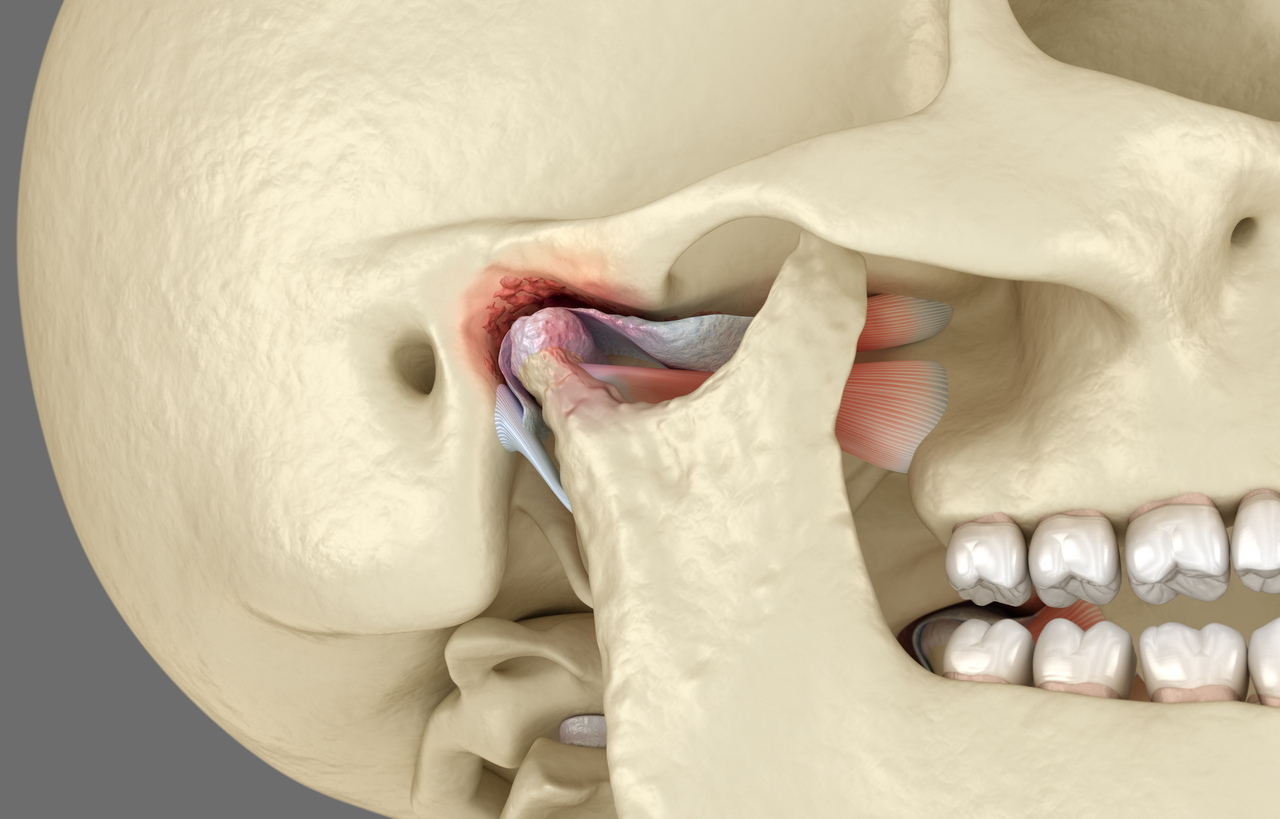
The temporomandibular joint is where your mandible — your lower jaw — connects to your skull.
Put your fingers immediately in front of your ears and slowly open and close your mouth. The movement underneath your fingers is your TMJ.
But this isn't a simple hinge.
During the beginning of mouth opening, the jaw primarily rotates. As you continue opening, the mandibular condyle begins to translate forward.
Between the mandibular condyle and the temporal bone sits a small fibrocartilaginous structure called the articular disc.
That disc helps the joint move smoothly and distribute forces through the TMJ.
And that brings us to one of the questions we hear all the time.
What Is That Little Pop When I Open My Mouth?
Often, that familiar TMJ click is related to something called disc displacement with reduction.
The articular disc isn't necessarily sitting where we'd ideally expect it relative to the mandibular condyle when your mouth is closed.
As you open your mouth and the jaw translates forward, the condyle can move back underneath the disc.
Click.
As you close, the relationship can change again, sometimes producing a second click.
That's why some people can reproduce almost exactly the same pop every time they open their mouth.
The important part:
A clicking jaw isn't automatically a damaged jaw.
TMJ clicking and disc displacement can occur in people who have no pain and perfectly acceptable function. A click by itself doesn't necessarily need to be "fixed."
We're more interested when that click comes with:
- Pain
- Restricted opening
- Locking
- Significant deviation during opening
- Difficulty chewing
- A sudden change in jaw mechanics
- Facial pain
- Headaches
- Significant muscle tenderness or tension
That's when figuring out why the mechanics have changed becomes important.
Your Jaw Has a Lot More Muscles Than You Think
Most people know about the masseter.
Clench your teeth and put your fingers on the sides of your jaw. That big muscle that immediately pops out?
That's your masseter.
But it's only one piece of a surprisingly complicated system.
The muscles and surrounding tissues we may evaluate in someone with TMJ dysfunction include:
- Masseter
- Temporalis
- Medial pterygoid
- Lateral pterygoid
- Digastric
- Mylohyoid
- Geniohyoid
- Stylohyoid
- Other suprahyoid and infrahyoid muscles
- Sternocleidomastoid
- Scalenes
- Suboccipitals
- Other cervical musculature
Not every one of these muscles directly moves the TMJ.
But together they help coordinate the jaw, tongue, hyoid, head, and neck every time you talk, chew, swallow, yawn, breathe, or clench your teeth.
That's why treating only the spot that hurts isn't always enough.
Why We Use ART and Manual Therapy for TMJ Dysfunction
When we evaluate someone with TMJ pain, we're looking for more than tenderness.
We want to know:
How does the jaw open?
Does it move straight or deviate toward one side?
How far can you comfortably open?
Where does the click occur?
Which muscles are tender or overactive?
What is happening at the neck?
And importantly:
Does the movement change when we treat a particular structure?
Depending on what we find, treatment may include Active Release Techniques (ART), myofascial work, trigger-point therapy, intraoral techniques, and other forms of manual therapy directed toward the tissues controlling or influencing the jaw.
Masseter
This is usually the easiest muscle for patients to understand because they can feel it themselves.
If you're clenching or grinding your teeth, the masseter can become remarkably tense and tender.
Manual therapy here can help decrease muscle sensitivity and may make jaw movement more comfortable.
Temporalis
The temporalis is the large, fan-shaped muscle along the side of your skull.
It helps close and retract the jaw.
It's also one reason TMJ dysfunction and headaches can overlap.
People will frequently point directly to their temples when describing a headache without realizing they're pointing at one of their primary chewing muscles.
When temple pain accompanies jaw tenderness, clenching, or altered TMJ mechanics, we'll usually evaluate the temporalis rather than assuming the headache and jaw are completely unrelated.
Medial Pterygoid
Now we're getting into muscles most people have never heard of.
The medial pterygoid sits deep along the inside of the mandible and acts somewhat like an internal partner to the masseter.
When it's irritated or overactive, it may contribute to jaw pain, altered mechanics, and difficulty comfortably opening the mouth.
Because of its location, effectively addressing it may involve intraoral manual therapy.
Yes — that means inside the mouth.
It's not everyone's favorite part of the visit, but when the examination points us there, it can be a useful piece of treatment.
Lateral Pterygoid
The lateral pterygoid is particularly interesting in TMJ dysfunction.
It participates in moving the mandible forward and in side-to-side jaw movement. It also has a close anatomical relationship with the TMJ capsule and disc-condyle complex.
If the jaw isn't translating normally, deviates significantly during opening, or reproduces symptoms with certain movements, the lateral pterygoid is one of the structures we'll consider.
It's another deep structure that may require careful intraoral treatment when appropriate.
What Do the Pterygoids Have to Do With Headaches?
This is where TMJ treatment gets especially interesting.
The muscles of mastication can become painful and sensitized, and pain arising from these tissues isn't necessarily perceived only at the muscle itself.
Pain can be experienced through the jaw, face, temple, or surrounding regions.
That's one reason we may evaluate the pterygoids and other chewing muscles in patients whose headaches occur alongside:
- Jaw clenching or grinding
- TMJ pain
- Temple tenderness
- Facial tension
- Painful chewing
- Neck tension
- Altered jaw movement
Working on the pterygoids isn't a universal headache treatment.
Headaches have many potential causes, and new, severe, unusual, or neurologically associated headaches require appropriate evaluation.
But when a headache has a clear musculoskeletal and TMJ component, treating the jaw and surrounding musculature can be an important part of the bigger picture.
The Muscles Under Your Jaw Matter Too
Here's an area that gets overlooked surprisingly often.
Underneath your jaw is a network of muscles connecting the mandible, tongue, skull, and hyoid bone.
These include the:
Digastric, mylohyoid, geniohyoid, and stylohyoid, along with the broader suprahyoid and infrahyoid system.
The hyoid itself is fascinating.
It's a small bone in the front of your neck that doesn't directly articulate with another bone. Instead, it's suspended by muscles and connective tissues.
Those muscles participate in swallowing, tongue movement, hyoid positioning, and jaw opening.
The digastric, for example, can assist in depressing the mandible when the hyoid is stabilized.
So when someone has TMJ dysfunction, we aren't necessarily stopping our examination at the edge of the jaw.
Sometimes the tissues underneath it are part of the problem.
Why Does Working on My Neck Make Me Feel It Behind My Ear?
This is one of those strange sensations that makes much more sense once you look at the anatomy.
While working through the anterior and lateral neck — particularly around the scalenes and hyoid-associated musculature — patients will occasionally feel a sharp, pulling, or even burning sensation that refers toward the area underneath or behind the ear.
One structure we consider here is the stylohyoid.
The stylohyoid runs from the hyoid bone up to the styloid process of the temporal bone, an attachment point located in the region just beneath the ear.
The styloid region is also anatomically crowded. Several muscles and ligaments attach nearby, including structures associated with the tongue, pharynx, mandible, and hyoid.
That means tension felt behind the ear isn't necessarily coming from the ear itself.
When we're doing manual therapy through the anterior neck, we'll sometimes find restricted or sensitive tissue planes between the scalenes and neighboring hyoid musculature. Working through those tissues can reproduce a patient's familiar pulling or burning sensation near the styloid region.
It's a great example of why where you feel something isn't always where the problem originates.
What About Adjusting the Jaw?
Chiropractic treatment for TMJ dysfunction may also include gentle mobilization or adjustment of the temporomandibular joint when the examination suggests joint mechanics are contributing to the problem.
This is very different from aggressively trying to "put the jaw back into place."
We're looking at movement.
Can the condyle translate appropriately?
Does one side move differently than the other?
Does the jaw deviate during opening?
Is movement restricted?
Is there a direction that reproduces the patient's symptoms?
When appropriate, we can use specific manual forces to influence motion at the TMJ.
Sometimes we'll also address restrictions in the cervical or upper thoracic spine when they're contributing to the overall presentation.
But like everything else we do at Ascent:
An adjustment is a tool. It isn't the entire treatment plan.
The Neck and Jaw Are Closely Connected
This is another reason we rarely examine the jaw in isolation.
Head position changes the mechanical environment surrounding the jaw.
Cervical muscles interact functionally with the muscles controlling the mandible and hyoid.
And sensory information from the trigeminal and upper cervical systems converges within pathways involved in head and facial pain.
So when someone comes in with:
jaw pain + neck pain + headaches
we're probably going to evaluate all three.
Sometimes the problem is predominantly muscular.
Sometimes the TMJ itself is more involved.
Sometimes cervical dysfunction is contributing.
And frequently, it's a combination.
That's why the examination matters.
Clicking Doesn't Always Need to Be "Fixed"
This is worth repeating.
If your jaw has clicked for 15 years, doesn't hurt, doesn't lock, and you can eat, talk, yawn, and open your mouth normally, I'm probably not going to make eliminating that click the primary goal of treatment.
A painless click can simply represent the way your particular TMJ is moving.
We're much more concerned about function and symptoms than making every joint in your body completely silent.
On the other hand, a jaw that suddenly starts clicking and hurting, begins locking, loses range of motion, or significantly changes the way it opens deserves an evaluation.
How We Approach TMJ Dysfunction at Ascent
Our approach follows the same basic philosophy we use throughout the body:
Mobility → Stability → Strength → Power
Obviously, we're probably not trying to turn your lateral pterygoid into a powerlifter.
But the progression still matters.
1. Evaluate
We look at jaw opening and closing, lateral movement, tenderness, clicking, range of motion, cervical mechanics, muscle function, and relevant neurologic or orthopedic findings.
2. Restore Mobility
When appropriate, treatment may include:
- ART
- Manual therapy
- Intraoral soft-tissue techniques
- TMJ mobilization or adjustment
- Hyoid and anterior-neck manual therapy
- Cervical and thoracic treatment
The goal isn't simply to make something feel looser for 20 minutes.
We want to improve the movement we're actually seeing.
3. Improve Control
Once we have better movement, we want the system to control that movement.
Depending on the patient, that might include controlled jaw-opening exercises, tongue-position drills, cervical stabilization, breathing mechanics, or other movement work.
4. Address the Bigger Picture
Sometimes the jaw isn't something we should manage alone.
Significant bruxism, dental problems, sleep-related grinding, trauma, persistent locking, substantial joint pathology, or other conditions may warrant collaboration with a dentist, physical therapist, oral/maxillofacial specialist, physician, or another appropriate provider.
That's an important part of our treatment philosophy at Ascent.
No ego.
The goal isn't to make every problem a chiropractic problem.
The goal is to figure out what you actually need.
Jaw Pain Is Often More Than Just the Jaw
TMJ dysfunction is a great example of why we don't like treating the body as a collection of unrelated parts.
The joint matters.
The articular disc matters.
But so do the masseter, temporalis, pterygoids, digastric, hyoid musculature, anterior neck, and cervical spine.
Sometimes improving a stubborn jaw means treating structures you didn't even realize were connected to it.
Sometimes that nagging temple headache leads us right back to the muscles controlling your jaw.
And sometimes that strange burning sensation behind your ear leads us down into the muscles of the anterior neck.
The important part isn't chasing every tight muscle we can find.
It's figuring out which structures are actually affecting your movement and symptoms — and treating accordingly.