
.png)





Shoulder pain has a way of making otherwise simple tasks surprisingly frustrating. Reaching into the back seat, putting on a jacket, lifting something onto a shelf, sleeping on one side, pressing in the gym, or carrying gear can suddenly become uncomfortable.
One of the most common structures associated with this type of shoulder pain is the rotator cuff.
You may have heard terms like rotator cuff tendinitis, tendinopathy, impingement, bursitis, or even partial-thickness tear. Those diagnoses can be useful, but they don't always tell us everything we need to know about why a shoulder hurts—or what that particular shoulder needs to get back to normal activity.
At Ascent, we want to identify the likely pain generator while also asking a bigger question:
What is keeping this shoulder from comfortably handling the demands being placed on it?
That distinction matters because successful rehabilitation often involves much more than simply trying to make an irritated tendon feel better.
What Is the Rotator Cuff?
The rotator cuff is a group of four muscles and their tendons that surround the shoulder joint:
- Supraspinatus
- Infraspinatus
- Teres minor
- Subscapularis
Together, these muscles help produce shoulder rotation, but their job is much bigger than that. The rotator cuff helps control the position of the humeral head—the ball of the shoulder joint—as the arm moves.
That becomes especially important when you reach overhead, lift something away from your body, throw, press, pull, or perform repetitive shoulder movements.
The cuff also doesn't work by itself. Shoulder function depends on coordinated movement between the upper arm, shoulder blade, rib cage, and thoracic spine. That's one reason evaluating only the location of pain can miss part of the picture.
What Does Rotator Cuff Tendinopathy Feel Like?
Rotator cuff-related shoulder pain can present differently from person to person, but common complaints include:
- Pain along the outside or front of the shoulder
- Pain reaching overhead or away from the body
- Discomfort lowering the arm after reaching overhead
- Pain putting on a coat or reaching behind the back
- Pain when lifting or carrying
- Difficulty sleeping on the affected shoulder
- Pain with pressing, throwing, swimming, climbing, or other repetitive upper-body activity
- A feeling of weakness or reduced confidence in the shoulder
Some people can point to a specific activity that started the problem. Others notice it gradually.
That's where understanding load and capacity becomes particularly useful.
Rotator Cuff Pain Is Often a Capacity Problem
Tendons are designed to tolerate load. In fact, appropriate loading is part of what helps tendons remain strong.
Problems can arise when the demands placed on a tendon exceed what it is currently prepared to tolerate.
Think of it as a relationship:
Demand > Current Capacity = Potential Irritation
Sometimes demand changes quickly. You start a new lifting program, dramatically increase your pressing volume, spend a weekend doing overhead construction work, return to throwing, or suddenly perform an activity your shoulder hasn't done in months.
That's especially relevant here in Alaska. Shoulder demands can change quickly with the seasons—paddling and fishing all summer, hunting in the fall, shoveling snow, handling skis and snowboards, climbing, or returning to different gym activities throughout the year.
But the other side of the equation matters too.
Capacity can decrease.
If a shoulder hasn't been loaded meaningfully for months, previously normal activity may suddenly represent a substantial increase in demand. Pain can then lead to more avoidance, which can further reduce strength and tolerance.
That's why simply resting until nothing hurts isn't always the complete solution.
Pain Generator vs. Movement Problem
This is an important distinction.
The rotator cuff tendon may legitimately be the tissue producing pain. We don't need to pretend anatomy doesn't matter.
But identifying a painful supraspinatus tendon, for example, doesn't automatically explain why that tendon became symptomatic.
During an evaluation, we may also find limitations in shoulder mobility, reduced thoracic motion, altered scapular mechanics, weakness or poor endurance of the rotator cuff, reduced pulling or pressing capacity, or simply a recent workload that exceeded what the shoulder was prepared to tolerate.
Two people with nearly identical diagnoses can therefore need very different rehabilitation programs.
This is also why terms such as rotator cuff tendinopathy, shoulder impingement, and subacromial pain can overlap considerably in the real world. They describe useful pieces of the clinical picture, but they aren't substitutes for examining how the shoulder actually moves and performs.
What About a Rotator Cuff Tear?
This is where shoulder imaging can create a lot of anxiety.
An MRI report may describe tendinosis, fraying, degeneration, or a partial rotator cuff tear. Those findings shouldn't be ignored, but they also need to be interpreted alongside the person's history, strength, function, symptoms, and mechanism of injury.
Not every structural finding seen on imaging is necessarily responsible for someone's pain.
Likewise, the presence of a rotator cuff tear does not automatically mean surgery is required. Many rotator cuff-related problems can initially be managed conservatively, depending on the individual circumstances.
There are important exceptions.
A significant traumatic injury followed by substantial weakness or loss of shoulder function deserves appropriate evaluation. Progressive neurological symptoms, suspected fracture or dislocation, systemic illness, or other concerning findings can also change the plan.
The goal isn't to dismiss imaging. It's to put the imaging into context.
Rehabilitation Should Build the Shoulder Back Up
Once serious pathology has been ruled out, our goal usually isn't permanent protection of the shoulder.
It's to help the shoulder become capable again.
At Ascent, we often think about rehabilitation through a progression of mobility → stability/control → strength → power or performance.
That doesn't mean everyone mechanically progresses through the same four stages. It gives us a framework for identifying what is actually limiting the person in front of us.
Mobility: Can You Get Where You Need to Go?
Before loading a movement aggressively, we need to know whether the shoulder can comfortably access the necessary range.
That may include looking at shoulder flexion, abduction, internal and external rotation, thoracic mobility, and how the scapula moves along the rib cage.
Not every patient needs more mobility. Some already have plenty.
The goal is adequate mobility for the task, not simply making every joint as mobile as possible.
Stability and Control: Can You Control That Range?
Having motion and controlling motion are different things.
The rotator cuff and scapular musculature need to coordinate as the arm moves. If someone can reach overhead but loses control as load is introduced, that becomes an important rehabilitation target.
Early exercises may therefore emphasize controlled shoulder motion, cuff activation, scapular control, and tolerable loading.
Strength: Can the Shoulder Handle Meaningful Load?
This is where rotator cuff rehabilitation sometimes gets stuck.
Light resistance bands can be useful. They aren't necessarily the finish line.
As symptoms settle and tolerance improves, rehabilitation should generally become more challenging. Depending on the individual, that might include progressively loaded external rotation, rows, pulldowns, carries, pressing variations, and other upper-body movements.
The exact exercise matters less than matching the exercise to the person's current ability and progressively increasing the demands.
The objective is not to create a shoulder that's really good at rehabilitation exercises. It's to build a shoulder that's prepared for life outside the clinic.
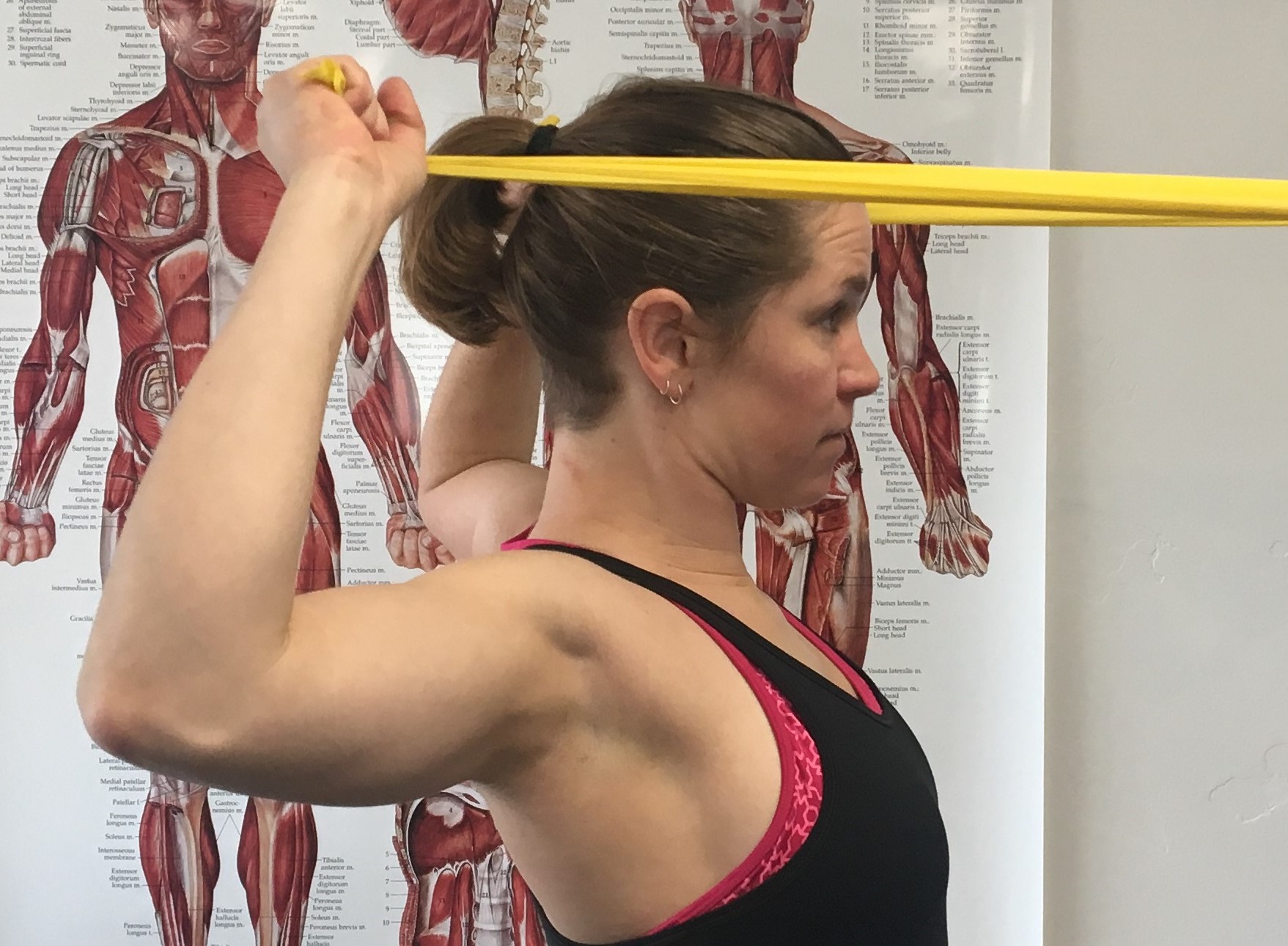
Shoulder rehabilitation should progress beyond simply avoiding painful movements. Appropriate loading helps rebuild strength, control, and the capacity needed for work, training, and recreation.
Power and Performance: Can It Handle Your Activity?
For some people, getting back to normal daily activity is the goal.
For others, that's only the beginning.
A shoulder used for throwing, climbing, skiing, paddling, demanding physical work, or higher-level strength training has to tolerate greater forces, faster movements, and repeated loading.
Rehabilitation should eventually reflect those demands.
A pain-free band exercise doesn't necessarily tell us whether your shoulder is ready for a heavy overhead press, a day of casting, repeated work overhead, or pulling yourself onto a ledge.
Return-to-activity decisions should look like the activity you're returning to.
Where Do Manual Therapy and Other Treatments Fit?
Hands-on treatment can be useful when pain or mobility restrictions are preventing someone from moving and loading comfortably.
Depending on the examination, treatment might involve manual therapy to the shoulder or surrounding tissues, treatment of relevant cervical or thoracic restrictions, or other strategies intended to improve short-term motion and tolerance.
In selected cases, additional treatments may also be considered.
But passive treatment shouldn't automatically replace rehabilitation.
If treatment helps the shoulder move more comfortably today, we want to use that opportunity to restore movement and progressively load it. Ultimately, the shoulder needs enough capacity to tolerate what you ask of it after you leave the clinic.
Should You Exercise Through Rotator Cuff Pain?
Not every sensation during rehabilitation means you're causing damage.
At the same time, “just push through it” isn't a particularly useful rehabilitation strategy either.
We generally care about the entire response to loading: how much discomfort occurs during an exercise, whether mechanics substantially change, how symptoms behave afterward, and how the shoulder feels later that day and the following day.
Some discomfort may be acceptable during a well-designed progression. A significant or sustained increase in symptoms may tell us that the dosage needs to change.
The goal is to find a level of loading the shoulder can tolerate and progress from there.
Treat the Shoulder You Have, Not Just the Tendon Diagnosis
Two people can walk into Ascent with “supraspinatus tendinopathy” written on an MRI report and present very differently.
One may have plenty of mobility but poor rotator cuff strength.
Another may be strong but lack the overhead range needed for their sport.
Someone else may demonstrate good isolated shoulder strength but struggle to control the scapula under load.
And another person may move extremely well and simply have increased their training volume faster than their shoulder could adapt.
That's where I think our system at Ascent really shines.
Rather than assigning the same collection of “rotator cuff exercises” to everyone with shoulder pain, our physical therapy and rehabilitation model gives us a framework for determining what your shoulder is missing. From there, we can address the relevant mobility or movement limitations and progressively rebuild the strength and capacity required for the activities that matter to you.
Because ultimately, the goal isn't simply to have a shoulder that hurts less.
It's to build a shoulder you can trust again.