
.png)





Headache is one of those words we use to describe a lot of very different problems.
And somewhere along the way, "really bad headache" became almost synonymous with "migraine."
But severity doesn't determine whether a headache is a migraine.
Migraine is a specific neurological headache disorder with characteristic patterns. Tension-type headaches are different. Cervicogenic headaches are different. Cluster headaches are very different. Occipital neuralgia can produce intense pain that sometimes gets lumped into the migraine category as well.
And then there are plenty of people who don't fit neatly into one box.
They may have an established history of migraine but also develop headaches related to their neck. They may have features of both tension-type and cervicogenic headache. Or they may have spent years calling every headache a migraine without anyone really asking what the headache feels like, what triggers it, where it begins, and what happens when their neck is examined.
At Ascent, that's where we want to start.
Before deciding how to treat a headache, let's figure out what kind of headache we're dealing with — and whether there's a musculoskeletal component we can actually change.
Migraine: More Than Just a Bad Headache
Migraine can certainly be severe, but severity alone doesn't make a headache a migraine.
Migraine without aura classically involves recurrent attacks lasting hours to days, with features such as throbbing or pulsating pain, moderate-to-severe intensity, worsening with routine physical activity, and symptoms such as nausea or sensitivity to light and sound.
Some people experience an aura, which can include temporary visual, sensory, speech, or other neurologic symptoms associated with an attack.
Migraine also tends to have a history.
Many people with migraine can look back to adolescence or young adulthood and recognize a longstanding pattern. They may identify particular triggers or circumstances associated with their attacks — although triggers vary tremendously between people and aren't required for the diagnosis.
That's very different from someone who suddenly starts developing a new headache at age 50 after spending ten hours a day at a computer.
It's also important to understand that people with migraine can have neck pain.
Neck pain doesn't automatically turn a migraine into a cervicogenic headache.
Someone can also have migraine and a separate mechanical neck problem. That's why we're interested in the entire history rather than trying to force every headache into one category.
Tension-Type Headache
Tension-type headache is extremely common and often feels quite different from classic migraine.
These headaches are more commonly described as:
- Pressure or tightness rather than throbbing
- Pain on both sides of the head
- A band-like sensation around the forehead, temples, or back of the skull
- Mild-to-moderate intensity
- Pain that isn't substantially aggravated by ordinary physical activity
Muscular tenderness around the neck, shoulders, jaw, and scalp can accompany these headaches.
And despite the name, "tension-type" doesn't simply mean you're stressed.
Stress, sleep, prolonged work, muscular fatigue, jaw clenching, workload, and many other factors can potentially interact with someone's headache pattern.
For some patients, the cervical and muscular components are substantial enough that they're worth addressing as part of a broader management strategy.
Cervicogenic Headache: When the Neck Is Part of the Problem
A cervicogenic headache is a secondary headache, meaning the headache is attributed to a disorder or problem involving structures of the cervical spine or neck.
This is where the examination becomes especially important.
Someone may describe pain that begins around the upper neck or base of the skull and travels into the back, side, or front of the head. Neck movement or sustained positions may aggravate it. Cervical range of motion may be limited, and examination of the neck may reproduce the person's familiar headache.
The International Classification of Headache Disorders specifically recognizes reduced cervical motion and significant worsening of headache with provocative neck movements as evidence that can help establish a cervical contribution.
That's very different from simply saying:
"Your neck hurts, therefore your headache comes from your neck."
We want evidence that the two are actually connected.
Occipital Neuralgia: When the Occipital Nerves Become Irritated
Occipital neuralgia deserves its own discussion because it can be remarkably painful.
People may describe sharp, shooting, stabbing, burning, or electric pain beginning around the base of the skull and traveling upward across the posterior scalp. The scalp itself may become sensitive or painful.
And the anatomy here gets really interesting.
The greater occipital nerve arises primarily from C2 and travels through the upper cervical and suboccipital region before ascending across the posterior scalp.
The lesser occipital nerve, primarily associated with C2 with variable C3 contribution, travels toward the lateral posterior scalp and region behind the ear.
The greater occipital nerve has particularly close relationships with several muscles and fascial structures in the upper cervical region.
That doesn't mean every case of occipital neuralgia is simply a "tight muscle pinching a nerve."
Human anatomy — and headache — isn't that simple.
But it does mean that when someone has an occipital neuralgia-type presentation, we're interested in what's happening around the upper cervical spine and the tissues surrounding the nerve's course.
Before We Jump Straight to an Injection, Is There Something Mechanical We Can Address?
Occipital nerve blocks and other medical interventions absolutely have a place.
For persistent or significant occipital neuralgia, physicians may use local anesthetic injections, sometimes combined with corticosteroid, both diagnostically and therapeutically.
We're not opposed to that.
But particularly when a person's examination suggests a meaningful musculoskeletal component, we think there's another reasonable question worth asking:
Is there something mechanical here that we can address?
Is there significant muscular guarding around the suboccipital region?
Can we reproduce the familiar symptoms by examining those tissues?
Is upper cervical movement restricted or painful?
Is the person's neck being asked to tolerate more sustained load than it currently has the capacity to handle?
Could manual therapy, Active Release Techniques, appropriately selected chiropractic treatment, exercise, or a combination of those approaches improve the mechanical component?
If the answer is yes, conservative care may be worth exploring before — or sometimes alongside — more invasive options.
The goal isn't to compete with an injection.
The goal is to understand why the region is irritated and determine whether there's something we can meaningfully change.
Cluster Headache: A Very Different Headache
Cluster headaches are another reason we shouldn't call every severe headache a migraine.
Cluster headache is a primary headache disorder characterized by attacks of extremely severe pain, usually around or behind one eye or the temple.
Attacks often occur in recognizable periods or "clusters" and can be accompanied by symptoms on the painful side such as tearing, eye redness, nasal congestion, eyelid changes, or facial sweating.
People are often restless or agitated during an attack rather than wanting to lie quietly in a dark room.
This is not a headache we try to explain by finding a tight muscle at the base of the skull.
Recognizing when a presentation doesn't fit a mechanical headache is just as important as recognizing when it does.
And Sometimes Headaches Overlap
Real patients aren't always textbook cases.
Someone can have migraine and cervical dysfunction.
Someone can have a tension-type headache with substantial neck and shoulder tenderness.
A patient with an established migraine disorder can develop a completely separate cervicogenic headache after an injury.
And sometimes the distinction between tension-type and cervicogenic headache isn't obvious.
That's why our first question isn't:
"Where should we adjust?"
It's:
"What does this headache actually look like?"
Why the Upper Neck Can Matter So Much
To understand why we spend so much time examining the upper cervical region in certain headache patients, we need a quick anatomy lesson.
At the base of your skull are four small muscles collectively called the suboccipital muscles:
- Rectus capitis posterior major
- Rectus capitis posterior minor
- Obliquus capitis superior
- Obliquus capitis inferior
They're tiny compared with the large muscles running along your spine.
But they're not unimportant.
Quite the opposite.
The suboccipital region has an important role in proprioception — your nervous system's ability to determine where your head and neck are positioned in space — and in the fine control of head movement.
Information from the cervical proprioceptive system integrates with visual and vestibular information as your nervous system coordinates head position, gaze, balance, and orientation.
These little muscles are built for precision.
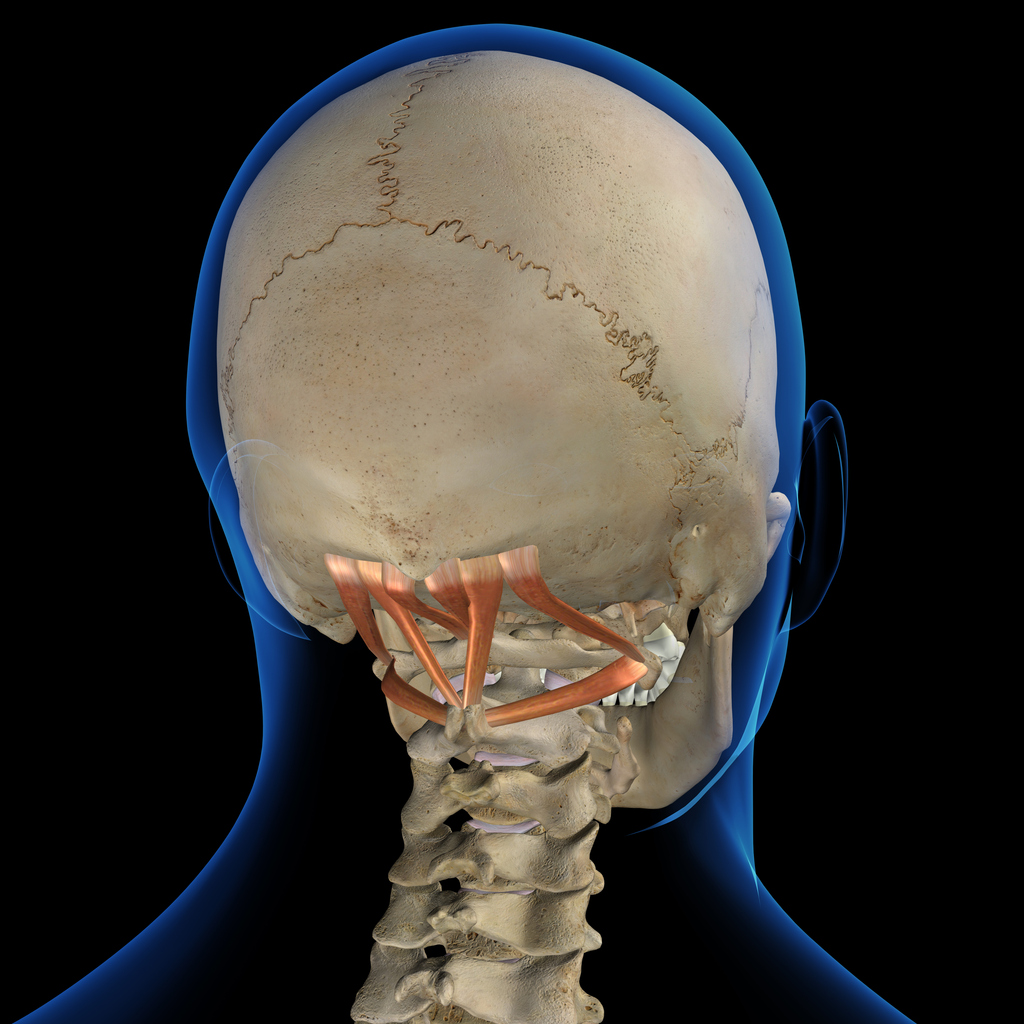
The four suboccipital muscles sit deep at the base of the skull: rectus capitis posterior major and minor, and obliquus capitis superior and inferior. Their location and sensory role make this region particularly interesting when evaluating certain headache patterns.
Your Suboccipitals Weren't Designed to Be Full-Time Erector Muscles
Now think about what happens after several hours at a computer.
Your thoracic spine settles forward.
Your shoulders may begin to round.
Your head gradually translates farther in front of your torso.
But there's a problem:
Your eyes still need to look at the screen.
So the movement isn't simply your entire neck falling forward.
As the head translates anteriorly and the lower cervical region flexes, the upper cervical region commonly compensates with relative extension to keep your face and eyes oriented forward.
And those little muscles at the base of the skull?
They're now being asked to help maintain that position.
For hours.
Then you leave work and look down at your phone.
Then you drive home.
Then you open your laptop.
Then you sit on the couch and watch television.
The issue isn't that there's one universally "bad" posture that everyone needs to avoid.
The bigger issue is load, duration, variability, and capacity.
Any position becomes more interesting when your body has to maintain it for hours and the tissues responsible for doing that work don't have enough capacity for the demand.
For some people, sustained anterior head carriage can contribute to fatigue, tenderness, guarding, and altered movement through the upper cervical and suboccipital region.
And remember what's traveling through this same neighborhood:
the occipital nerves.
Now we have a much more interesting clinical picture than simply telling someone to "sit up straight."
What We Look For During a Headache Examination
Before treating anything, we want the story.
When did the headaches begin?
Did you have them as a child or teenager?
Are they new?
How often do they occur?
How long do they last?
Where does the pain begin?
Is it throbbing, pressure, burning, stabbing, or electric?
One side or both?
Do you experience nausea?
Light or sound sensitivity?
Visual symptoms?
Does physical activity make it worse?
Does neck movement change it?
Does working at your computer affect it?
Have you identified consistent triggers?
Has the pattern recently changed?
Then we examine.
Depending on the presentation, that may include cervical range of motion, neurologic testing, upper cervical joint assessment, palpation of the suboccipital musculature, assessment of the occipital region, thoracic movement, scapular mechanics, cervical endurance, and other relevant orthopedic testing.
One finding we're particularly interested in is reproduction of the patient's familiar headache.
If examining a particular upper cervical structure consistently reproduces the headache you walked in complaining about, that gives us more useful information than simply finding a random tender spot.
What Chiropractic Treatment for Headaches Looks Like at Ascent
There isn't a "headache adjustment."
And every headache patient shouldn't receive the same treatment.
When the examination suggests a meaningful cervical or musculoskeletal component, treatment may involve several different tools.
Suboccipital Manual Therapy
We frequently work directly with the tissues at the base of the skull.
That can include focused manual therapy and Active Release Techniques through the suboccipital musculature and surrounding cervical tissues.
We're looking for areas of significant guarding, tenderness, altered tissue movement, and — importantly — whether treating those findings changes the patient's familiar symptoms.
Upper Cervical Adjusting
When we identify an appropriate joint restriction, an upper cervical adjustment may be useful.
But again:
We're not adjusting because someone has a headache.
We're adjusting because the examination identified a mechanical finding that we believe is appropriate to address.
Depending on the patient, we may also treat lower cervical or thoracic restrictions that appear to be contributing to the overall movement pattern.
Rehabilitation
This is the part that shouldn't get lost.
Passive treatment may help reduce symptoms and restore movement.
But if your neck becomes exhausted every afternoon because it doesn't have the capacity to tolerate your workday, we haven't solved much by repeatedly loosening it up.
We need to build capacity.
That may mean working on:
- Deep cervical flexor control and endurance
- Cervical stabilization
- Scapular control
- Thoracic mobility where it's actually limited
- Upper-back strength
- Pulling strength
- Workstation modifications
- Movement variability throughout the workday
The specific exercises depend on what we find.
But the overall progression is familiar:
Restore the motion that's actually missing.
Build control.
Build strength and endurance.
Then make sure the body can tolerate real life.
Research on cervicogenic headache supports this kind of multimodal approach. Manual therapy can help with headache intensity and frequency, particularly in the short term, while cervical exercise appears valuable for longer-term management. The research isn't perfect, and there isn't one universally superior protocol, but the evidence supports combining appropriate manual treatment with active rehabilitation rather than relying exclusively on passive care.
What If It Really Is Migraine?
Then we treat it like migraine.
That may mean medical management is the most important component.
What we don't want to do is tell someone with a neurological migraine disorder that we found "the bone that's causing their migraines."
That's not an accurate way to describe migraine.
But remember: having migraine doesn't make you immune to neck problems.
If someone with migraine also has substantial cervical dysfunction, restricted motion, muscular tenderness, poor cervical endurance, or a separate cervicogenic headache component, those findings may still be appropriate for us to address.
We're simply clear about what we're treating.
Our goal isn't to claim that an adjustment cures migraine.
Our goal is to determine whether there is a musculoskeletal component that belongs in our lane.
When a Headache Needs Medical Evaluation
Most headaches aren't medical emergencies.
But headache is also an area where recognizing something unusual matters enormously.
A headache deserves prompt medical evaluation when the history or examination raises concern for something more serious — particularly a sudden, severe headache unlike anything you've experienced before; a major change in an established headache pattern; new significant neurologic symptoms; headache associated with fever or severe systemic illness; headache following significant trauma; or other concerning findings identified during the examination.
A new or unusual headache isn't something we automatically adjust first and ask questions about later.
We ask the questions first.
If your presentation doesn't look like something that belongs in our office, we'll tell you.
That's part of good chiropractic care too.
Don't Treat the Label. Figure Out the Headache.
If you tell us you have migraines, we're going to believe that your head hurts.
But we're probably going to ask a lot more questions.
Because "migraine," "headache," and "neck headache" aren't interchangeable diagnoses.
Sometimes the headache really is migraine.
Sometimes it's tension-type.
Sometimes the cervical spine is a significant contributor.
Sometimes an irritated occipital nerve appears to be involved.
Sometimes several things are happening simultaneously.
And occasionally, the history tells us that this isn't a routine headache at all.
That's why our goal at Ascent isn't simply to find somewhere to adjust.
It's to understand the headache first.
When there is a meaningful mechanical component, we can work through the muscles and joints involved, restore appropriate movement, build cervical and upper-quarter capacity, and help address some of the demands that may keep recreating the problem.
When the problem belongs somewhere else, we want you in the right place.
Because ultimately, good headache care isn't about proving that chiropractic works for every headache.
It's about figuring out which parts of the problem we can actually help.
Sources
International Headache Society. International Classification of Headache Disorders, 3rd edition (ICHD-3). Diagnostic classifications for migraine, tension-type headache, cluster headache, cervicogenic headache, and other headache disorders.
Bini P, Hohenschurz-Schmidt D, Masullo V, Pitt D, Draper-Rodi J. The effectiveness of manual and exercise therapy on headache intensity and frequency among patients with cervicogenic headache: a systematic review and meta-analysis. Chiropractic & Manual Therapies. 2022;30:49.
Núñez-Cabaleiro P, Leirós-Rodríguez R. Effectiveness of manual therapy in the treatment of cervicogenic headache: A systematic review. Headache. 2022;62(3):271–283.
Varangot-Reille C, Suso-Martí L, Dubuis V, et al. Exercise and Manual Therapy for the Treatment of Primary Headache: An Umbrella and Mapping Review. Physical Therapy. 2022;102(3).
Castien R, et al. Research examining exercise and manual therapy approaches for cervicogenic and primary headache disorders.
National Center for Biotechnology Information. Occipital Neuralgia. StatPearls. Anatomy, clinical presentation, evaluation, and management of occipital neuralgia.