
.png)



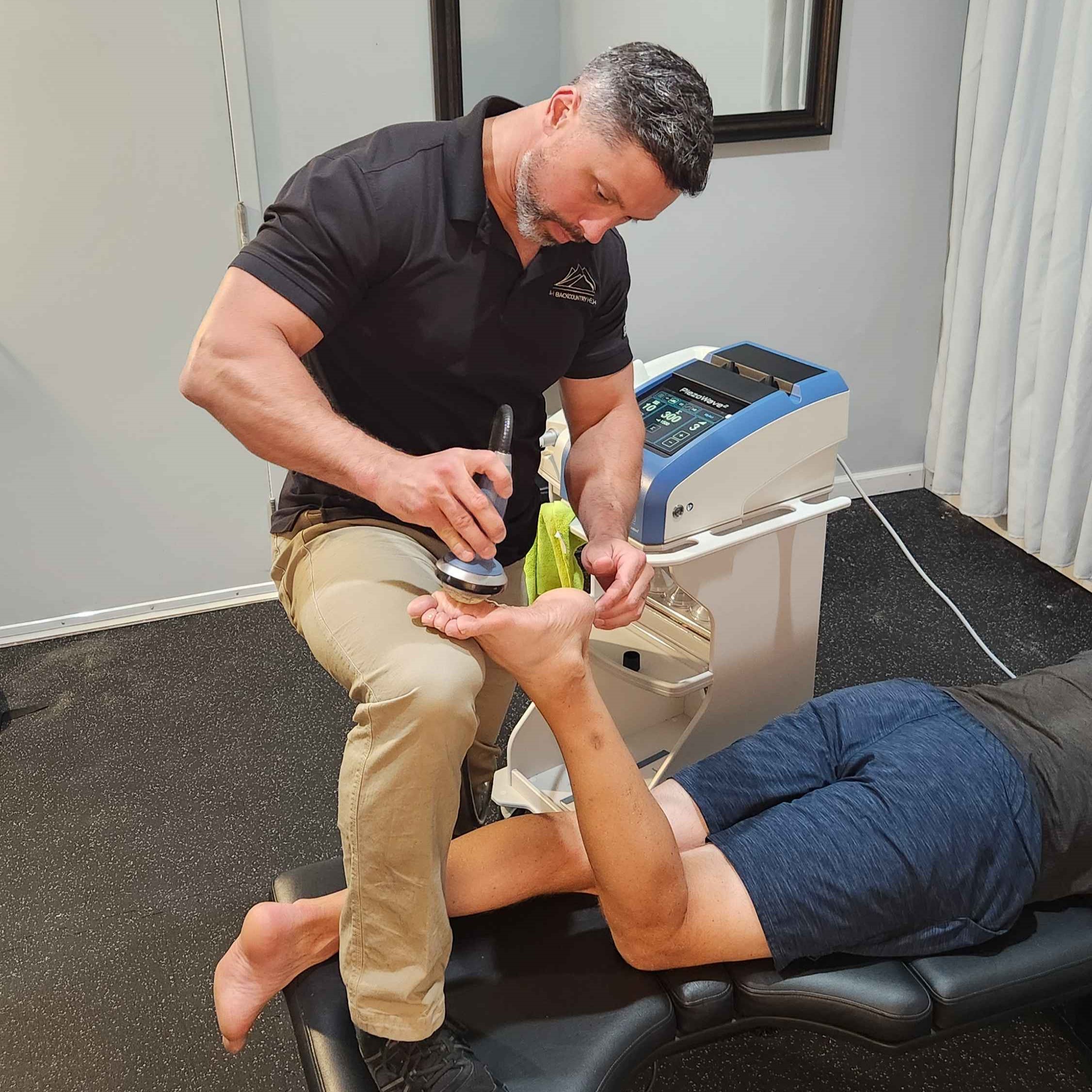

Focused shockwave therapy has become one of our favorite tools for treating stubborn musculoskeletal problems at Ascent Health & Performance.
But it isn't a magic wand, and it isn't appropriate for every painful body part.
Shockwave tends to be most useful when we're dealing with chronic tendon problems, certain bone and soft-tissue conditions, or an injury that has stopped responding to the usual combination of rest, activity modification, manual therapy, and rehabilitation.
The important part is figuring out what tissue is actually causing the problem first.
Here’s how focused shockwave works, what a treatment feels like, and some of the conditions where the research is most promising.
What Is Focused Shockwave Therapy?
Focused shockwave therapy uses acoustic pressure waves that travel through the skin and can be concentrated at a specific depth within the body.
That's an important distinction.
Focused shockwave isn't simply vibration or percussion applied to the surface. The treatment can be directed toward a specific tendon, attachment, calcification, muscle, or other target tissue.
At Ascent, we use focused shockwave as part of a broader treatment strategy. The goal isn't simply to make something hurt less for a few hours. We want to identify the irritated tissue, improve its capacity to tolerate load, and ultimately get you back to the activities that matter to you.
What Happens During a Focused Shockwave Session?
Treatment starts with an evaluation.
Before putting a shockwave applicator on anything, we want to understand why it hurts. That may include orthopedic testing, movement assessment, palpation, strength testing, and occasionally reviewing diagnostic imaging.
Once we've identified an appropriate treatment target, gel is applied to the skin to transmit the acoustic waves efficiently.
The applicator is positioned over the target tissue and treatment begins at a tolerable intensity. From there, we can adjust the treatment based on the tissue, treatment depth, condition, and your response.
A typical treatment itself usually takes only several minutes, although the overall appointment may also include reassessment, manual treatment, mobility work, or rehabilitation.
What Does Shockwave Therapy Feel Like?
You'll know we're doing something.
Most people describe focused shockwave as a rapid tapping, pulsing, or deep pressure sensation. Healthy tissue may barely bother you, while an irritated tendon or attachment can be surprisingly sensitive.
Treatment shouldn't become a contest to see how much discomfort you can tolerate. We adjust the intensity throughout the session and use your feedback to guide treatment.
Some patients feel improvement quickly. Others are mildly sore afterward, similar to what you might experience following a challenging workout.
More importantly, the biological response we're trying to create continues after you leave the office.
What Does Focused Shockwave Do at the Cellular Level?
This is where shockwave gets interesting.
The mechanical stimulus created by shockwaves produces biological responses within tissue—a process generally referred to as mechanotransduction.
Research suggests extracorporeal shockwave therapy can influence several processes involved in tissue remodeling and pain modulation, including:
- Cellular signaling involved in tissue repair
- Local vascular and angiogenic responses
- Tendon remodeling and collagen-related activity
- Modulation of pain signaling
- Bone-forming activity in certain applications
- Changes associated with calcific deposits
The exact response depends on the tissue being treated, dosage, energy level, treatment protocol, and underlying condition.
That's also why we don't think of shockwave as something that simply “breaks up scar tissue.” The biological response is considerably more interesting—and more nuanced—than that.
The 20 Conditions We Consider for Focused Shockwave Therapy
1. Plantar Fasciitis / Plantar Fasciopathy
This is one of the most established applications for shockwave therapy.
Chronic plantar heel pain can become frustrating when stretching, shoe changes, orthotics, rest, and exercise aren't getting someone over the hump. Shockwave may help reduce pain and improve function, particularly in persistent cases.
We still address calf strength, foot mechanics, activity tolerance, footwear, and loading rather than treating the plantar fascia in isolation.
2. Achilles Tendinopathy
The Achilles tendon responds to load—but chronic tendinopathy sometimes needs help getting the remodeling process moving in the right direction.
Shockwave can be paired with progressive calf loading to address persistent midportion or insertional Achilles symptoms.
For runners, hikers, skiers, and athletes here in Alaska, our ultimate goal isn't simply a less tender Achilles. It's rebuilding enough capacity to tolerate the activities you want to return to.
3. Patellar Tendinopathy
Commonly called jumper's knee, patellar tendinopathy frequently affects athletes involved in jumping, sprinting, squatting, and other high-force activities.
Shockwave may be useful as an adjunct to progressive tendon loading when symptoms have become persistent.
4. Lateral Epicondylitis
Tennis elbow doesn't require you to play tennis.
Repetitive gripping, lifting, construction work, climbing, weight training, and racquet sports can all overload the common extensor tendon on the outside of the elbow.
Shockwave is one option for persistent cases, particularly when combined with progressive strengthening of the forearm and upper extremity.
5. Medial Epicondylitis
Golfer's elbow affects the tendons along the inside of the elbow.
As with lateral elbow tendinopathy, treatment shouldn't end at the painful attachment. Grip capacity, wrist strength, shoulder mechanics, workload, and sport or occupational demands may all matter.
6. Calcific Rotator Cuff Tendinopathy
This is one of the conditions that makes shockwave particularly interesting.
Calcium deposits can develop within rotator cuff tendons—most commonly the supraspinatus—and may contribute to significant shoulder pain and restricted movement.
Shockwave has been studied for both symptom improvement and changes in calcific deposits, with some of the strongest evidence supporting higher-energy focused treatment for appropriate calcific cases.
7. Non-Calcific Rotator Cuff Tendinopathy
Shoulder pain without calcification is more complicated.
Shockwave may be considered for selected chronic rotator cuff tendinopathies, but exercise and progressive loading remain fundamental. We also evaluate scapular mechanics, shoulder mobility, strength, and cervical contribution rather than simply treating wherever it hurts.
8. Greater Trochanteric Pain Syndrome / Gluteal Tendinopathy
Persistent pain along the outside of the hip is often labeled “bursitis,” but the gluteal tendons frequently play an important role.
Shockwave has shown promising results for greater trochanteric pain syndrome and can be combined with progressive hip strengthening and modification of aggravating loads.
9. Proximal Hamstring Tendinopathy
Deep pain near the sitting bone can become particularly stubborn in runners and athletes.
Shockwave may provide another treatment option while we progressively rebuild hamstring strength, hip control, and tolerance to running, hinging, sprinting, or other provocative activities.
10. Myofascial Pain and Trigger Points
Shockwave can also be applied to selected muscular pain presentations.
The goal isn't literally to “break up knots.” Mechanical stimulation may influence pain sensitivity, muscle tone, circulation, and local tissue response.
This is generally one component of treatment rather than a stand-alone solution.
11. Delayed-Union and Nonunion Fractures
Shockwave has a long history in orthopedic applications involving bone healing.
Higher-energy focused shockwave has been investigated for delayed-union and nonunion fractures because mechanical stimulation can influence osteogenic activity.
These cases require appropriate imaging, diagnosis, and coordination with orthopedic care. This isn't something we casually treat because a bone still hurts.
12. Bone Stress Injuries
Some difficult bone stress injuries may be considered for shockwave treatment, particularly when healing has been delayed.
Again, diagnosis matters. Suspected stress fractures should be properly evaluated before treatment, and return-to-sport decisions should be based on healing and progressive loading—not simply pain reduction.
13. Early-Stage Osteonecrosis of the Femoral Head
Extracorporeal shockwave therapy has been investigated for early osteonecrosis, or avascular necrosis, of the femoral head.
There is promising research in selected early-stage cases, but this is a significantly different clinical situation than treating tennis elbow or plantar fasciitis and should involve appropriate orthopedic evaluation and imaging.
14. Knee Osteoarthritis
Research suggests shockwave may improve pain and function in some people with knee osteoarthritis.
We don't present shockwave as a way to “regrow a worn-out knee.” Instead, it may provide a useful window for reducing symptoms while strength, mobility, body composition when relevant, and overall activity capacity are addressed.
15. Pes Anserine Pain
Pain along the inside of the knee can involve the pes anserine tendons and adjacent bursa.
Shockwave may be considered in persistent soft-tissue presentations after determining that the symptoms aren't primarily coming from the knee joint, meniscus, MCL, or another structure.
16. Iliotibial Band–Related Lateral Knee Pain
The IT band itself isn't something we expect to permanently “loosen.”
Shockwave may help with pain modulation in selected cases, but treatment should also address training volume, hip strength, running mechanics when relevant, and other factors contributing to lateral knee loading.
17. Biceps Tendinopathy
Persistent irritation of the long head of the biceps can contribute to anterior shoulder pain.
Shockwave may be considered in selected chronic cases, but because biceps symptoms often coexist with rotator cuff, labral, or scapular problems, a proper shoulder examination matters.
18. Selected Ligament Injuries
There is emerging research into shockwave-assisted healing of certain ligament injuries.
This isn't currently one of the strongest or most established indications for shockwave, so we consider it selectively and as an adjunct to appropriate rehabilitation—not a replacement for it.
19. Morton's Neuroma
Some research has investigated shockwave for symptomatic Morton's neuroma.
Results are promising enough to make it a potential conservative option in selected patients, but footwear, mechanical compression, differential diagnosis, and severity of nerve involvement all need consideration.
20. Selected Peripheral Nerve Conditions
This is an emerging area of shockwave research rather than an established blanket indication.
Early studies suggest extracorporeal shockwave may influence nerve regeneration and neuropathic symptoms in certain circumstances. We would not treat unexplained numbness, weakness, or neuropathy with shockwave before determining why those symptoms are occurring.
The Important Part: Shockwave Isn't the Whole Treatment
This may be the most important point in this article.
Shockwave can change the environment. Rehab builds the capacity.
If your Achilles hurts because it can't tolerate the demands you're placing on it, reducing pain without rebuilding calf capacity doesn't finish the job.
If your shoulder feels better after shockwave but still lacks strength and control overhead, you're not done.
If plantar fascia pain improves but you immediately return to the same training volume that overwhelmed it, we haven't solved the entire problem.
At Ascent, focused shockwave therapy is typically integrated with some combination of:
- Progressive rehabilitation
- Strength training
- Mobility work
- Manual therapy when appropriate
- Load and activity modification
- Movement retraining
- Gradual return to sport or recreation
The goal is not dependence on treatment.
The goal is getting you back to doing what you want to do.
Is Focused Shockwave Therapy Right for You?
Maybe—but the diagnosis comes first.
Shockwave tends to make the most sense when we have an identifiable treatment target and a condition for which the therapy has reasonable clinical or research support.
If you've been dealing with a stubborn tendon, heel, shoulder, elbow, hip, or other musculoskeletal problem that hasn't responded the way you expected, an evaluation can help determine why it's still bothering you and whether focused shockwave belongs in the treatment plan.
At Ascent Health & Performance in Anchorage, we combine focused shockwave therapy with movement assessment and progressive rehabilitation rather than treating it as a stand-alone fix.
Schedule an evaluation and we'll determine whether shockwave makes sense for your condition—and what else needs to happen to get you back to full capacity.
Sources
- Mani-Babu S, Morrissey D, Waugh C, Screen H, Barton C. The effectiveness of extracorporeal shock wave therapy in lower limb tendinopathy: a systematic review. American Journal of Sports Medicine. 2015.
- Rompe JD, Furia J, Maffulli N. Eccentric loading versus eccentric loading plus shock-wave treatment for midportion Achilles tendinopathy: a randomized controlled trial. American Journal of Sports Medicine. 2009.
- Aqil A, Siddiqui MRS, Solan M, Redfern DJ, Gulati V, Cobb JP. Extracorporeal shock wave therapy is effective in treating chronic plantar fasciitis: a meta-analysis of randomized controlled trials. Clinical Orthopaedics and Related Research. 2013.
- Gerdesmeyer L, Wagenpfeil S, Haake M, et al. Extracorporeal shock wave therapy for the treatment of chronic calcifying tendonitis of the rotator cuff: a randomized controlled trial. JAMA. 2003.
- Rompe JD, Segal NA, Cacchio A, Furia JP, Morral A, Maffulli N. Home training, local corticosteroid injection, or radial shock wave therapy for greater trochanter pain syndrome. American Journal of Sports Medicine. 2009.
- Wang CJ. Extracorporeal shockwave therapy in musculoskeletal disorders. Journal of Orthopaedic Surgery and Research. 2012.
Research on extracorporeal shockwave therapy varies substantially by condition, device type, energy level, and treatment protocol. Some applications above have considerably stronger clinical evidence than others and should not be interpreted as equally established indications.