
.png)




Frozen shoulder can be frustratingly slow to change. Reaching overhead becomes difficult. Reaching behind the back may feel nearly impossible. Sleep can become uncomfortable, and even simple tasks such as putting on a jacket or fastening a seat belt can become a daily reminder that the shoulder is not moving normally.
The clinical name for frozen shoulder is adhesive capsulitis. It involves progressive pain and restriction of the shoulder joint capsule, often affecting several directions of motion at once. Recovery can take months—and sometimes considerably longer—which is why researchers continue to investigate treatments that might improve motion while patients work through an appropriate rehabilitation program.
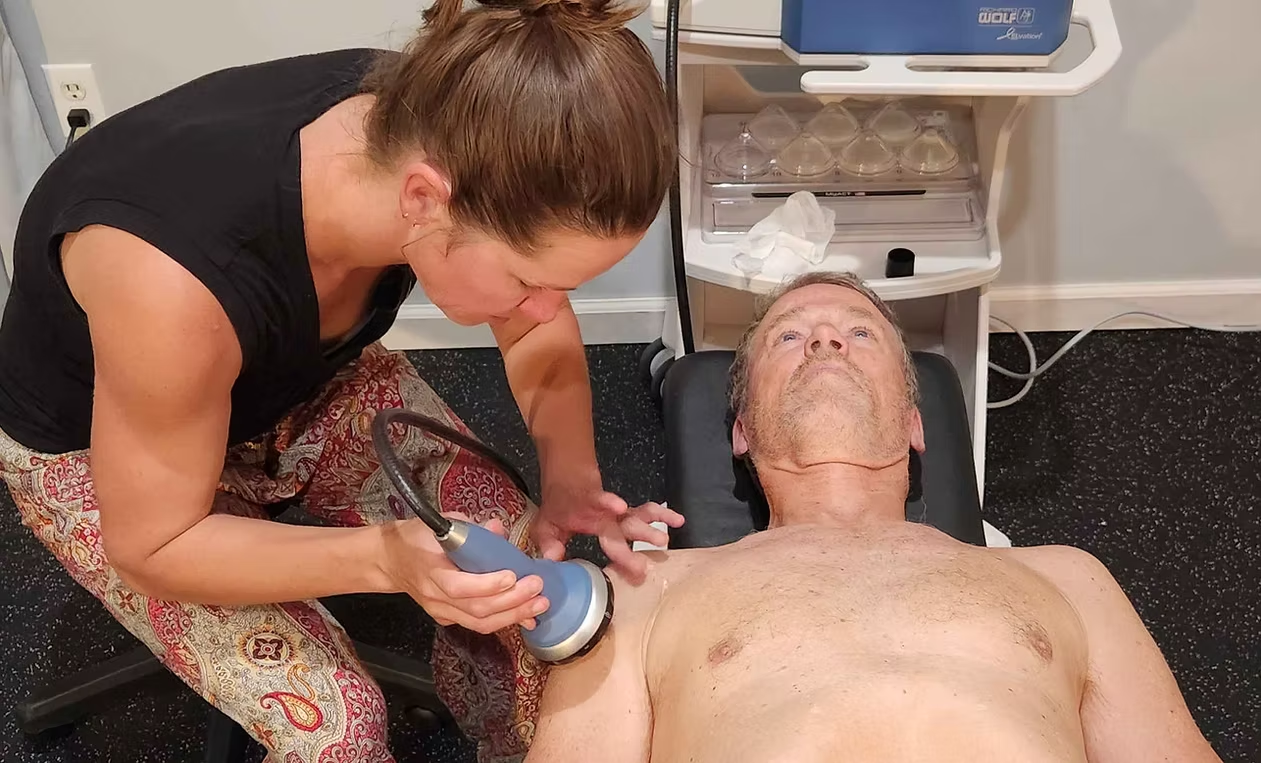
A new randomized clinical trial is especially relevant to us at Ascent Health & Performance because the researchers used the PiezoWave2 focused-shockwave system, the same platform we use in our Anchorage clinic. Their question was straightforward: if focused shockwave is used for a stiff, persistent frozen shoulder, does the number of pulses matter?

What the researchers studied
The trial included 48 adults with adhesive capsulitis that had not responded to at least three months of conservative care. Participants were randomly assigned to receive one focused-shockwave treatment using one of two dosages:
- 3,000 total pulses
- 6,000 total pulses
Both groups were treated at an energy flux density of 0.182 mJ/mm² and a frequency of 4 Hz. The pulses were divided across three regions around the shoulder: anterior, lateral and posterior to the acromion. This was intended to address the shoulder capsule more broadly rather than target one small tendon lesion.
After treatment, both groups were given a home mobility program including wall walks, towel-assisted internal rotation and assisted external rotation exercises. Shoulder range of motion was measured immediately after treatment and again at 1, 2, 4, 8 and 12 weeks. Function was reassessed at 12 weeks.
What the study found
The 6,000-pulse group experienced greater improvements than the 3,000-pulse group in:
- Forward flexion
- Abduction
- External rotation
- Internal rotation
- Overall shoulder function
Interestingly, the largest changes in motion occurred immediately after treatment, while the difference between groups remained evident at the 12-week follow-up.
That does not mean a frozen shoulder was “fixed” in one session. It does suggest that, within the protocol tested, 6,000 focused-shockwave pulses produced a stronger response than 3,000 pulses.
This distinction matters. Shockwave research is often discussed as though the treatment is simply on or off: a patient either received shockwave or did not. In reality, the device, type of shockwave, energy, number of pulses, treatment location and accompanying rehabilitation may all influence the result.

Why using the same PiezoWave2 system matters
“Shockwave therapy” is a broad label. Radial pressure-wave devices and true focused-shockwave systems do not deliver energy into tissue in the same way, and protocols from one system cannot automatically be transferred to another.
This study used focused shockwave delivered by PiezoWave2. That makes its treatment parameters far more relevant to our clinical decision-making than a study performed with an unrelated device.
It is still not a ready-made prescription for every painful or stiff shoulder. Adhesive capsulitis must first be differentiated from other problems that can restrict motion, including rotator-cuff pathology, calcific tendinopathy, arthritis, cervical referral and pain-related guarding. The participants in this study underwent imaging to support the diagnosis and exclude competing shoulder conditions.
Shockwave should create an opportunity for rehabilitation
One of the most useful details in this trial is that treatment did not stop when the shockwave session ended. Participants were given exercises intended to reinforce and expand the available motion.
That fits how we think about focused shockwave at Ascent. The goal is not simply to apply energy to a painful area and wait. If treatment produces a meaningful reduction in pain or a temporary increase in motion, that window should be used intentionally.
Depending on the individual, the next step might include:
- Gentle shoulder mobility within an appropriate tolerance
- Scapular control and positioning
- Progressive rotator-cuff loading
- Gradual exposure to reaching overhead and behind the body
- Restoration of pushing, pulling, carrying and other functional patterns
The exact progression depends on the stage and irritability of the shoulder. Aggressively forcing a highly reactive frozen shoulder is not the same as progressively loading a shoulder that is beginning to tolerate more movement.
What this study does not prove
The results are encouraging, but the limitations are important.
First, the trial compared 6,000 pulses with 3,000 pulses. It did not include a sham-treatment group, an exercise-only group or a group receiving no shockwave. We therefore cannot use it to conclude that one session of PiezoWave2 is superior to well-designed rehabilitation or another established treatment.
Second, the study included only 48 participants and followed them for 12 weeks. Adhesive capsulitis can evolve over a much longer period, so we do not know whether the difference between protocols persists over six months or a year.
Third, the study tested a single treatment session. It does not tell us whether one high-dose treatment is better than several lower-dose sessions, nor does it establish the ideal schedule for combining focused shockwave with manual therapy or progressive exercise.
Finally, both groups performed home mobility work. The results should be understood as the response to focused shockwave within a broader management plan, not evidence for shockwave as a stand-alone cure.
Our takeaway at Ascent
This study gives us a useful, clinically relevant signal: when treating carefully diagnosed, persistent adhesive capsulitis with PiezoWave2, dosage may matter. It also gives us a protocol worth examining because it reports the device, energy, frequency, pulse count and treatment regions rather than vaguely stating that “shockwave” was performed.
It does not justify treating every stiff shoulder with 6,000 pulses, and it does not replace an examination. What it does support is a more thoughtful approach:
- Confirm that the presentation is consistent with adhesive capsulitis.
- Record meaningful baseline measures, including multiple directions of shoulder motion and functional limitations.
- Select shockwave parameters intentionally rather than using a generic dosage for every condition.
- Recheck motion and symptoms after treatment.
- Use any improvement to guide an individualized mobility and loading progression.
That is where focused shockwave is most useful: not as a magic wand, but as one tool that may help a stubborn shoulder become more receptive to movement and rehabilitation.
If shoulder pain and stiffness are keeping you from training, sleeping comfortably or doing everyday activities, Ascent Health & Performance can evaluate what is limiting the shoulder and determine whether focused shockwave, rehabilitation or another care pathway makes the most sense.
Beyond Pain, Chase Adventure.
Study source
Tseng W-J, Chen S-F, Lai T-J, et al. High-dose extracorporeal shockwave therapy restores shoulder motion in adhesive capsulitis after a single session. JSES International. 2026. https://doi.org/10.1016/j.jseint.2026.101757
This article is for educational purposes and does not replace an individualized examination, diagnosis or treatment plan.