
.png)




If you've ever said, “I stretch all the time, but I still feel tight,” you're not alone.
Most people assume that feeling tight means they aren't flexible enough—and that more stretching is the solution.
But if stretching alone solved the problem, foam rollers and yoga straps would have eliminated stiff hips and cranky backs a long time ago. And don't get me wrong: I love my foam roller and straps.
The problem is that flexibility and mobility aren't the same thing.
Flexibility describes how much range is available. Mobility describes how well you can actually use it.
Understanding that difference can change how you approach stiffness, movement limitations, training, and rehab.
What Is Flexibility?
Flexibility generally refers to the ability of muscles and surrounding tissues to lengthen and allow a joint to move through a range of motion.
Think about:
- Pulling your leg toward you with a stretching strap
- Sinking deeper into a stretch with gravity helping
- Having someone move your hip or shoulder through a range while you stay relaxed
In each case, an outside force is helping you access the range.
That range can absolutely be useful. Stretching can improve range of motion, and there are situations where increasing flexibility is an important part of rehab or training.
But having access to a position doesn't necessarily mean you can control that position yourself.
That's where mobility comes in.
What Is Mobility?
Mobility is your ability to actively move through and control an available range of motion.
That requires more than flexible muscles. It can involve:
- Strength
- Coordination
- Joint control
- Balance
- Motor control
- Tolerance to load
In practical terms, mobility is usable range of motion.
Consider the difference between lying on your back and pulling your knee toward your chest versus standing on one leg and actively lifting that knee toward your chest without leaning backward or losing balance.
Those movements may involve a similar joint range, but the second requires you to create and control the movement yourself.
You don't just have access to the range.
You can own it.
Why Stretching Feels Good—but Doesn't Always Last
There's a reason people keep stretching: it often feels good.
Stretching can temporarily change your perception of stiffness and increase your tolerance to a greater range of motion. For some people, that short-term change is exactly what they need.
The problem comes when stretching is the only thing being done.
If you gain additional range but never teach your body to actively control or produce force within that range, the change may have limited carryover to the things you actually want to do.
That's why someone can stretch their hamstrings every morning and still feel tight when they squat, run, ski, or bend over later that day.
The question isn't always:
“How do I make this muscle looser?”
Sometimes the better question is:
“Why don't I move well here?”
Feeling “Tight” Doesn't Always Mean You're Inflexible
“Tightness” is a sensation, not a diagnosis.
Sometimes a muscle really does have limited extensibility. But the sensation of tightness can also show up alongside:
- Limited joint motion
- Weakness or poor control at certain ranges
- Compensation elsewhere in the movement
- Previous injury
- Repetitive loading
- Fatigue
- Changes in training volume or activity
That's why repeatedly stretching the area that feels tight doesn't always solve the problem.
Your hamstrings, for example, may feel tight during a hinge because you're struggling to control your pelvis and trunk—not simply because your hamstrings need to become longer.
A shoulder may feel restricted overhead because of limitations at the shoulder itself, but thoracic movement, scapular control, strength, and movement strategy can also contribute.
The sensation tells us something.
It just doesn't always tell us why.
Mobility Without Strength Is Just Range
This is the piece that often gets missed.
If we want newly available motion to become useful, we usually need to do something with it.
That might mean progressing from:
Passive range → active range → controlled range → loaded range
For example, improving hip mobility might begin with a targeted stretch or joint-mobility exercise.
But we don't necessarily stop there.
We might follow it with controlled hip rotations, a split squat, a single-leg hinge, or another movement that asks you to actively use the range you just accessed.
Over time, appropriate loading can help turn “I can get into this position” into:
“I'm strong and comfortable in this position.”
That's a much more useful adaptation.
What Mobility Training Actually Looks Like
Mobility training doesn't have to mean spending another 30 minutes on the floor before every workout.
Good mobility work can be surprisingly simple.
Depending on the limitation and the person, it might include:
Controlled Joint Movement
Slowly moving a joint through the largest range you can control without forcing it.
End-Range Strength
Using isometrics, resistance, or body weight to build strength near the edges of your available motion.
Loaded Mobility
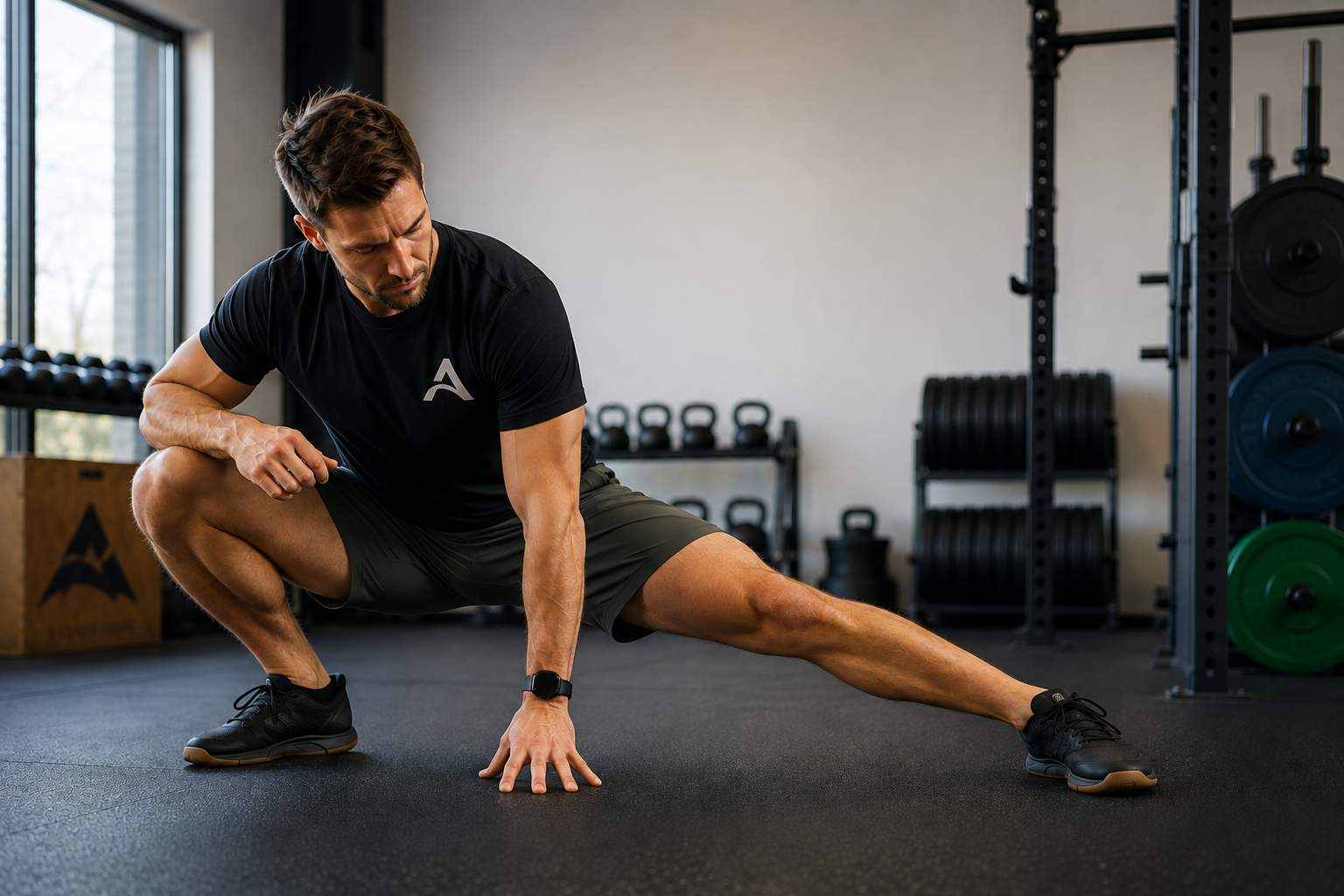
Exercises such as split squats, lateral squats, controlled step-downs, overhead carries, or appropriately loaded hinges can develop strength while moving through meaningful ranges.
Movement Integration
Eventually, the goal is to use that range during the activities that matter to you—whether that's lifting, running, skiing, hiking, working overhead, or simply getting down to the floor comfortably.
That's where mobility stops being an isolated exercise and starts becoming part of performance.
When Stretching Does Make Sense
None of this means stretching is bad.
Stretching is a tool—and a useful one.
It can make sense when you want to:
- Temporarily improve range of motion
- Reduce the sensation of stiffness
- Prepare a specific position before training
- Address a genuine flexibility limitation
- Restore motion as part of an appropriate rehab plan
- Simply stretch because it feels good
If five minutes of stretching helps you feel and move better, there's no reason to stop doing it.
The important question is what happens after you create that range.
If the goal is to make the change more useful, pair passive mobility work with active movement and, when appropriate, progressive resistance.
How We Approach Mobility at Ascent
At Ascent Health & Performance, we don't stop at asking:
“What's tight?”
We also want to know:
- Where is movement actually limited?
- Is passive motion different from active motion?
- Can you control the range that's available?
- What happens when we add load?
- Are you avoiding a position or compensating somewhere else?
- Does the limitation actually matter for the activity you're trying to get back to?
That distinction matters because two people who both complain of “tight hips” may need completely different approaches.
One may genuinely benefit from improving hip range.
Another may already have plenty of passive motion but lack the strength and control to use it.
A third may have symptoms that warrant a more complete evaluation rather than another mobility drill.
The goal isn't to make every joint as mobile as possible.
The goal is to develop enough motion—and enough control of that motion—for the things you need and want to do.
The Takeaway
Flexibility and mobility overlap, but they aren't interchangeable.
Flexibility gives you access to range.
Mobility helps you use and control that range.
Stretching can be valuable, particularly when a true range-of-motion limitation exists. But if you've been stretching the same area over and over without meaningful change, adding more stretching may not be the answer.
Look beyond what's tight.
Ask what you can control, where you're strong, how you move under load, and what your activity actually demands.
Because ultimately, the goal isn't just to move farther.
It's to move well—and have the capacity to do something with that movement.